


Most advice about facebook ads for contractors starts in the wrong place. It tells you to boost a post, pick a radius, throw up a few jobsite photos, and wait for calls.
That’s not a strategy. That’s hoping.
If you’re a remodeler chasing $75K+ projects, Facebook usually doesn’t work like Google. Google catches people who are already searching. Facebook gets in front of homeowners earlier, when they’re dreaming, comparing, watching, and deciding who feels trustworthy enough to invite into their home. If you treat Facebook like a shortcut to instant buyers, you’ll burn cash and blame the platform. If you treat it like a full lead-to-job system, it can become a reliable pipeline builder.
The biggest miss in most guides is simple. They stop at the lead. For high-ticket remodeling, the lead is only the start. The money comes from what happens next: clean targeting, strong creative, easy lead capture, fast CRM follow-up, estimate booking, and tracking closed jobs instead of vanity metrics.
Table of Contents
- Why Most Facebook Ads for Contractors Fail
- Getting Your Digital Toolbox Ready
- Finding the Right Homeowners in Your Town
- Creating Ads That Actually Stop the Scroll
- How to Budget and Launch Your Campaign
- Turning Clicks Into Customers with a Smart System
- Measuring What Matters for Real Growth
Why Most Facebook Ads for Contractors Fail
Most failed facebook ads for contractors have the same story behind them. The contractor boosted a post, got a few likes, maybe a message or two, and then decided Facebook leads are junk.
Boosting a post is not media buying. It’s the ad version of using a screwdriver to hammer a nail. The tool isn’t bad. It’s being used for the wrong job.
Facebook works best when you respect what it’s good at. It puts your company in front of homeowners who may not be ready today, but could be ready after they see your work a few times, visit your site, and remember your name when the main project conversation starts. That matters in remodeling, where people often think for months before they ask for estimates.
The real problem isn’t Facebook
The common failure points are usually these:
- Weak intent expectations. Contractors expect the same buyer mindset they get from Google. Facebook traffic is often colder.
- Bad creative. A truck photo, a logo, or a generic “Call us today” line won’t stop anyone.
- Loose targeting. Ads get shown to people outside your ideal neighborhoods or outside your budget tier.
- No follow-up system. A lead comes in, nobody responds quickly, and the opportunity dies.
- No job-level tracking. The owner judges the campaign on clicks or comments instead of booked estimates and signed contracts.
A helpful breakdown of these conversion problems shows up in Cometly’s guide on Why Your Facebook Ads Aren't Converting. It’s worth reading because it separates “bad platform” from “bad setup.”
Practical rule: Facebook is rarely the problem. The offer, audience, creative, or follow-up usually is.
What winning looks like
For a design-build firm, the goal isn’t cheap attention. It’s becoming familiar in the right pockets of town. When homeowners in your best neighborhoods keep seeing your kitchens, additions, baths, or outdoor projects, you stop feeling like a stranger.
That’s why the right mindset is simple. Don’t ask, “Can Facebook give me a lead today?” Ask, “Can Facebook help the right homeowners know, trust, and remember us before they call?” That’s how you build a pipeline instead of buying random clicks.
Getting Your Digital Toolbox Ready
Before you run ads, you need the basic pieces in place. Think of this like loading the truck before the crew leaves the shop. If the tools aren’t packed, the job gets sloppy fast.
Set up the account structure first
Your main pieces are:
- Business Manager. This is your control room. It holds your page, ad account, users, tracking tools, and permissions.
- Ad Account. This is the wallet for your campaigns.
- Facebook Page. This is the public face homeowners will check when they want to see if you look real.
- Instagram account. Optional, but useful if you want your ads to appear there too.
Your page doesn’t need to be fancy. It does need to look alive. Use a clean logo, service area, real project photos, a clear description of what you do, and contact details that match your website. If a homeowner clicks your ad and lands on a half-empty page, trust drops.
If you want extra ideas for how contractors use social content to build familiarity between ads, the roundup on social media for tradies gives practical examples without making it feel complicated.
Install your tracking before you spend
The Meta Pixel is your website’s security camera. It watches who visits key pages and what actions they take, like viewing a kitchen gallery or filling out a contact form.
The Conversions API is the backup generator. Browser tracking has gotten messier. Conversions API helps send data from your server or CRM back to Meta so your campaigns still learn from real actions.
If you skip this, Facebook has less signal. Less signal usually means weaker optimization and shakier lead quality.
Here’s the simple setup list:
- Put the Pixel on every page so Meta can learn from traffic across the whole site.
- Track meaningful actions like lead forms, consultation requests, and thank-you pages.
- Connect Conversions API so you’re not relying only on browser-based tracking.
- Check mobile pages because many homeowners will click from their phone.
- Match your site to the ad promise. If the ad says “Luxury kitchen remodeling in [City],” the page should show that.
A conversion-focused website matters more than most contractors realize. If you need a good model, this guide on how to design a remodeling website that converts visitors into leads is a useful benchmark for what your site should do after the click.
Your ad opens the door. Your website either invites the homeowner in or makes them leave.
Finding the Right Homeowners in Your Town
The fastest way to waste money on facebook ads for contractors is to target a whole metro and hope the algorithm sorts it out.
That approach fills the top of the funnel with people who live too far away, can’t afford the work, rent instead of own, or just like looking at pretty remodel photos. None of that helps you sell a serious project.

Stop targeting the whole city
In construction, Facebook ads carry a 27% higher average CPC of $1.41 than the global benchmark of $1.11, and the figure climbed to $2.22 in January 2026, which is exactly why contractors need sharper local targeting instead of broad waste (construction CPC benchmark data).
That means every loose click costs more than it should.
Start with a map, not the Ads Manager. Ask:
- Where have your best projects come from
- Which zip codes have the homes you want
- Where do homeowners value design, craftsmanship, and full-service remodeling
- Where can your team serve profitably without long-drive headaches
Then build your audience around those areas. For higher-ticket remodelers, zip-code targeting is often smarter than a giant radius. If you do use a radius, center it around neighborhoods where you’ve already completed strong projects.
Use Meta to expand inside the right fence
Meta’s newer broad and Advantage+ options can help, but only after you set the fence correctly. Don’t hand the platform a bad service area and expect it to find gold.
A simple targeting stack can look like this:
| Targeting layer | What it does | Why it matters |
|---|---|---|
| Primary location | Best zip codes or tight local radius | Keeps spend close to profitable neighborhoods |
| Homeowner fit | Homeowners, likely higher-income households, relevant life stage | Cuts out a lot of low-fit traffic |
| Project relevance | Home remodeling, kitchen design, outdoor living, home improvement interests | Gives Meta a starting clue |
| Advantage+ expansion | Lets Meta find similar people inside your area | Helps delivery without going fully broad |
If you already have past customer data, website traffic, or form leads, those inputs make targeting stronger. The machine learns faster when you give it examples of real prospects.
Your organic local presence helps too. A contractor with a polished Google Business Profile, strong reviews, and visible project photos feels more legitimate when someone sees the ad and does a quick search. A resource such as Google Business Profile for contractors therefore supports the paid side of the strategy.
Hyper-local beats hyper-broad for high-ticket remodeling. You don’t need more people. You need the right people in the right streets.
Creating Ads That Actually Stop the Scroll
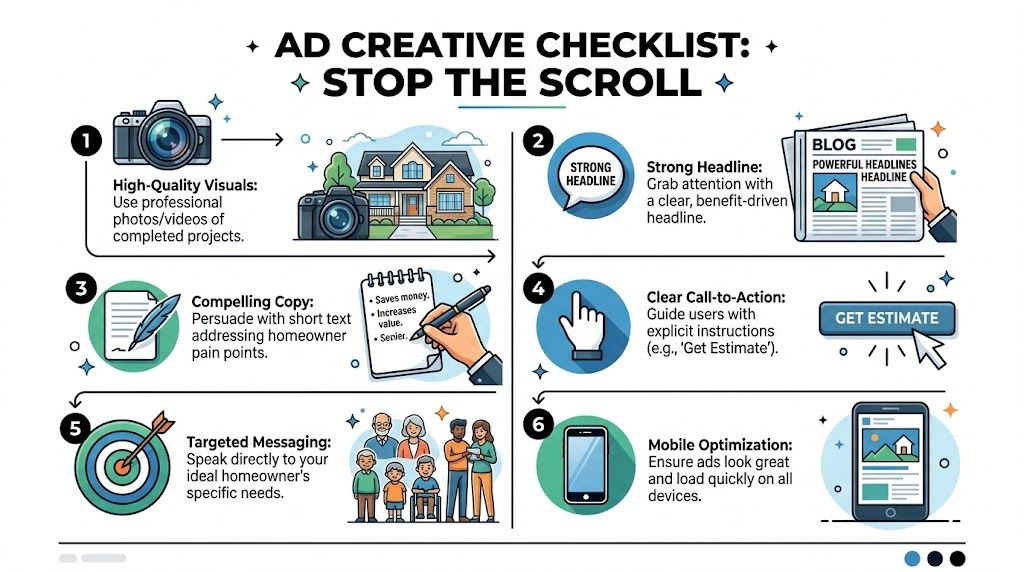
A homeowner isn’t sitting on Facebook waiting for your ad. They’re checking family photos, local groups, school updates, and neighborhood gossip. Your ad has to interrupt that pattern without feeling like a billboard.
A blurry truck photo won’t do it. Neither will a stock image of smiling people in hard hats.
What homeowners actually notice
The ads that get attention in remodeling usually have one of these angles:
- Before-and-after transformations that make the result obvious in one second
- Owner-intro videos where the company owner explains how the process works
- Project showcase carousels that walk through one kitchen, bath, addition, or outdoor project
- Craftsmanship clips showing details, materials, finishes, and the team at work
- Client testimonial videos that lower fear and build trust
Visual quality matters. The same source that tracks contractor ad testing notes that teams using a structured 5-phase testing methodology can see 25% to 40% performance gains quarterly, and a solid benchmark is CTR above 1.5%, often driven by strong visuals like testimonials and before-and-after galleries (5-phase testing benchmark).
That lines up with what works in the field. Homeowners don’t stop for generic claims. They stop for proof.
A simple ad formula that works
You don’t need fancy copywriting. You need clear copy. AIDA is enough.
Attention
Call out the problem or dream.
Interest
Show that you understand what the homeowner wants.
Desire
Make the result feel real and local.
Action
Tell them the next step.
Here’s what that sounds like in plain English:
Kitchen cramped and dated? We help homeowners in [City] turn closed-off layouts into bright, functional spaces built for real family life. See a recent local project and request a consultation.
Or for outdoor living:
Your backyard shouldn’t sit unused half the year. We design and build outdoor spaces that make it easier to host, relax, and enjoy your home.
Three ad examples that fit high-value jobs
The local project ad
Show one finished kitchen from the same town or a nearby neighborhood. Use the headline to name the city. Homeowners pay attention when the work feels close to home.The face behind the company ad
A short video from the owner can calm a lot of fear. People hiring for a major remodel want to know who they’re trusting.The process ad
Talk less about “we do amazing work” and more about how you guide the client. Design, selections, timeline, communication, and craftsmanship. That attracts people who value professionalism, not bargain hunters.
A few creative rules save a lot of money:
- Use real photos from your completed work, not polished stock images.
- Write headlines for homeowners, not for other contractors.
- Keep text short because mobile users decide fast.
- Match image to offer so the ad feels coherent.
- Test multiple versions instead of betting everything on one ad.
If your ad looks like an ad, people scroll. If it looks like proof from a trusted local company, people pause.
How to Budget and Launch Your Campaign
Most contractors either underspend and learn nothing, or overspend before the system is ready. A better move is to treat the first budget like paid testing.
You’re buying answers. Which audience responds, which creative gets attention, and which offer turns into real conversations.
Start with a test budget
For contractors, a practical starting range is $500 to $1,000 per month in local markets when testing lead generation campaigns (lead form ad budget guidance).
That’s enough to collect signal if your targeting is tight and your creative is decent.
Use Lead Form ads first if you want the easiest launch. They keep the homeowner on Facebook, which reduces friction. The same JobNimbus guidance says lead form ads can lift conversion rates by 30% to 40% compared with sending people to a website first when quote requests are the goal.
Watch a few numbers, not everything
You do not need to stare at every chart in Ads Manager. Start with a short scoreboard:
| Metric | What it means in plain English | Good use |
|---|---|---|
| CPL | What you paid for a lead | Tells you if lead capture is too expensive |
| CTR | How often people click after seeing the ad | Tells you if the ad is interesting |
| Lead quality | Whether the person fits your jobs | Tells you if targeting is working |
| Estimate booked | Whether the lead moved forward | Tells you if follow-up is working |
Facebook leads for contractors often land in the $15 to $50 CPL range, with typical close rates of 8% to 20%, which translates to $150 to $500 cost per acquisition for a closed job (Facebook vs Google lead cost comparison for contractors).
That’s why Facebook can work well for pipeline building, even when the buyer intent is lower than Google.
A clean launch plan
Keep the first campaign simple:
- Use one campaign objective. Lead generation is the cleanest starting point.
- Build one audience per service area cluster so you can see where leads come from.
- Run a few creative variations instead of one.
- Use a short form with only the questions you need.
- Review every week and shift budget toward what’s producing qualified conversations.
If your first month teaches you which zip codes, ads, and offers produce booked estimates, the spend did its job.
Turning Clicks Into Customers with a Smart System
Most contractor campaigns break here.
The ad works. The lead form works. Notifications come in. Then nothing happens because the owner is on a jobsite, the office is busy, or the message sits in Facebook until the next morning. By then, that lead has cooled off or contacted two other companies.

The handoff is where deals are won or lost
The biggest gap in most contractor Facebook ad strategies is the lead handoff. ServiceTitan’s contractor guidance notes that integrating ads directly with a CRM for automated follow-up is critical, and that contacting a lead within 5 minutes can improve conversion rates dramatically for high-ticket remodelers (contractor Facebook ad follow-up guidance).
That one detail changes everything.
A Facebook lead is often impulsive. The homeowner sees a project they like, taps the form, and submits. If you reply fast, the conversation feels natural. If you wait, the moment passes.
A CRM isn’t just software. It’s the person who answers when your team can’t.
What the follow-up system should do
For high-value jobs, the system should feel simple on the homeowner side and automatic on your side.
A strong setup usually does this:
- Instant lead capture from Facebook into your CRM
- Immediate text message thanking the lead and opening the conversation
- Email confirmation with next-step expectations
- Task assignment to the sales rep or office
- Missed-call text-back if someone calls while you’re unavailable
- Pipeline stages for new lead, qualified, consultation set, estimate sent, won, lost
A simple first text can be enough:
Hi [Name], this is [Company]. Thanks for reaching out about your remodeling project. We got your request. What’s the best time for a quick call?
That message works because it’s human, quick, and low pressure.
Why this matters more for six-figure jobs
Big projects don’t close because someone filled out a form. They close because the contractor looked organized from the first minute.
When the ad, CRM, and sales process are connected, you can sort serious homeowners from casual inquiries fast. You can also keep following up with people who aren’t ready yet. That matters because many remodeling buyers need time, spouse input, financing conversations, or design clarity before they book.
One practical resource if you’re trying to connect lead gen with a full contractor sales workflow is this guide to lead generation for contractors. It focuses on the bigger system instead of just the ad click.
If you’re choosing tools, options like GoHighLevel are common for this kind of automation. Constructo Marketing also uses a whitelabeled GoHighLevel CRM for contractors who want ad lead capture, follow-up automation, missed-call text-back, and pipeline tracking in one system.
Measuring What Matters for Real Growth
A lot of contractors lose faith in facebook ads for contractors because they measure the wrong things. They look at likes, comments, reach, or even raw lead count and think that tells the whole story.
It doesn’t.
A campaign can generate a pile of cheap leads and still lose money if those leads never turn into estimates or signed work.
Ignore vanity metrics
Clicks are not jobs. Reach is not revenue. Cheap leads are not always good leads.
The more useful questions are:
- How many leads turned into real conversations
- How many real conversations turned into estimates
- How many estimates turned into signed projects
- What did it cost to acquire one customer
- What return came back from the ad spend
Successful remodelers move past raw leads and track estimates booked and closed jobs inside the CRM. LeadsBridge also notes that, after iOS privacy changes, Meta’s Advantage+ campaigns have shown 15% higher ROAS when paired with broad audiences and CRM-tracked conversion events (CRM-based ROAS tracking for contractor campaigns).
That’s the right direction. The system has to connect ad activity to actual sales outcomes.
Build your scorecard around booked estimates and jobs
Your scorecard can stay simple. For each campaign, track:
| Stage | What to record | Why it matters |
|---|---|---|
| Lead | Name, source, service, location | Tells you what the ad brought in |
| Qualified | Budget fit, project type, timing | Filters out weak opportunities |
| Estimate booked | Date set, rep assigned | Shows real sales progress |
| Closed job | Revenue, win or loss | Reveals true return |
| Cost to acquire | Ad spend tied to won jobs | Shows whether the campaign is healthy |
A contractor who spends a modest amount and lands one strong remodel can have excellent economics. But you only know that if your tracking follows the lead all the way to the signed agreement.
The winning campaign is not the one with the cheapest lead. It’s the one that produces profitable jobs without chaos.
When you measure this way, Facebook stops feeling random. It becomes one part of a real growth system. Ads create awareness, forms capture interest, CRM automation handles the handoff, and your dashboard shows whether the effort is producing good work in the neighborhoods you want.
If you want help building that full lead-to-job system, Constructo Marketing works with remodelers on the pieces that usually break first: targeting the right local homeowners, creating ads that fit high-value projects, connecting leads into CRM follow-up, and tracking performance all the way through booked estimates and closed jobs.