


You’re probably living this right now.
One month the phone won’t stop ringing. You’re booked out, juggling estimates at night, and trying to keep crews happy. The next month gets quiet. You start checking the inbox too often, wondering where the next solid kitchen, bath, or addition job is coming from.
That’s not a marketing strategy. That’s survival mode.
Most contractors don’t have a lead generation problem. They have a system problem. They try random stuff. A few Google Ads. A half-finished website. Some referrals. Maybe a lead platform when things get slow. Nothing talks to anything else, so results bounce all over the place.
That’s why lead generation for contractors feels harder than it should. The issue usually isn’t effort. It’s that the parts aren’t connected.
Table of Contents
- Stop Riding the Lead Generation Rollercoaster
- Become The First Contractor Google Recommends
- Turn On the Faucet for Instant Qualified Leads
- Make Your Website Your Best Salesperson
- Automate Your Follow-Up and Never Miss a Lead
- How to Know If Your Marketing Is Actually Working
Stop Riding the Lead Generation Rollercoaster

Monday starts with two estimate requests, Wednesday is quiet, and Friday you are staring at the phone wondering where next month’s work will come from. That cycle burns up cash, forces bad decisions, and trains you to say yes to projects you should pass on.
A lot of contractors blame lead volume. The actual problem is the lack of a system.
Random tactics create random months
Referrals, lead sites, yard signs, a few Google clicks, maybe a Facebook post. None of that is wrong on its own. It fails when each piece lives by itself and nobody owns the full path from first click to signed job.
That is why some months feel strong and the next month falls apart. You are not running a pipeline. You are collecting random chances.
Exploding Topics reports that organizations generate an average of 1,877 leads per month, 50% of marketers rank lead generation as a top priority, and owned digital channels can reduce lead costs while pushing conversion rates above 20% for larger projects. For a contractor, the lesson is simple. You do not need a huge pile of leads. You need a steady flow of qualified homeowners, a clear sales process, and follow-up that happens every time.
Practical rule: More leads will not fix a broken process. Better leads plus faster follow-up will.
If you want larger jobs, stop renting your pipeline from third-party platforms and start building assets you control. Your Google presence, your website, your ads, your CRM, and your follow-up process should work together. If you are still choosing target terms for SEO by gut feel, learn how to find low competition keywords so you can go after searches you can win instead of fighting every contractor in town for the same broad terms.
What a real system looks like
A reliable lead system is simple to describe and hard to fake.
- Google visibility: Show up where local homeowners are already searching.
- Paid traffic: Create demand on purpose instead of waiting for it.
- A conversion-focused website: Give people a clear reason to call, book, or request an estimate.
- Fast follow-up: Use a CRM and missed-call text-back so good leads do not disappear while your crew is on a job site.
- Tracking: Tie calls, forms, estimates, and closed revenue back to the source.
Most contractors stop at the click. That is where they lose money. SEO, ads, and a polished website do not mean much if a missed call goes unanswered or a form sits in an inbox until tomorrow morning.
If you need a starting point for the visibility side, this guide to Google Business Profile for contractors covers one of the first pieces to get in order.
Lead generation for contractors works best as one connected system. Build it that way, and you stop guessing, stop chasing scraps, and start filling the calendar with the kind of work you wanted in the first place.
Become The First Contractor Google Recommends
When a homeowner searches for “kitchen remodel near me,” Google is acting like the local phone book. If your company isn’t showing up clearly, you’re invisible at the moment that buyer is ready to act.
That’s why Local SEO matters so much. It’s not nerd stuff. It’s basic trust signals.
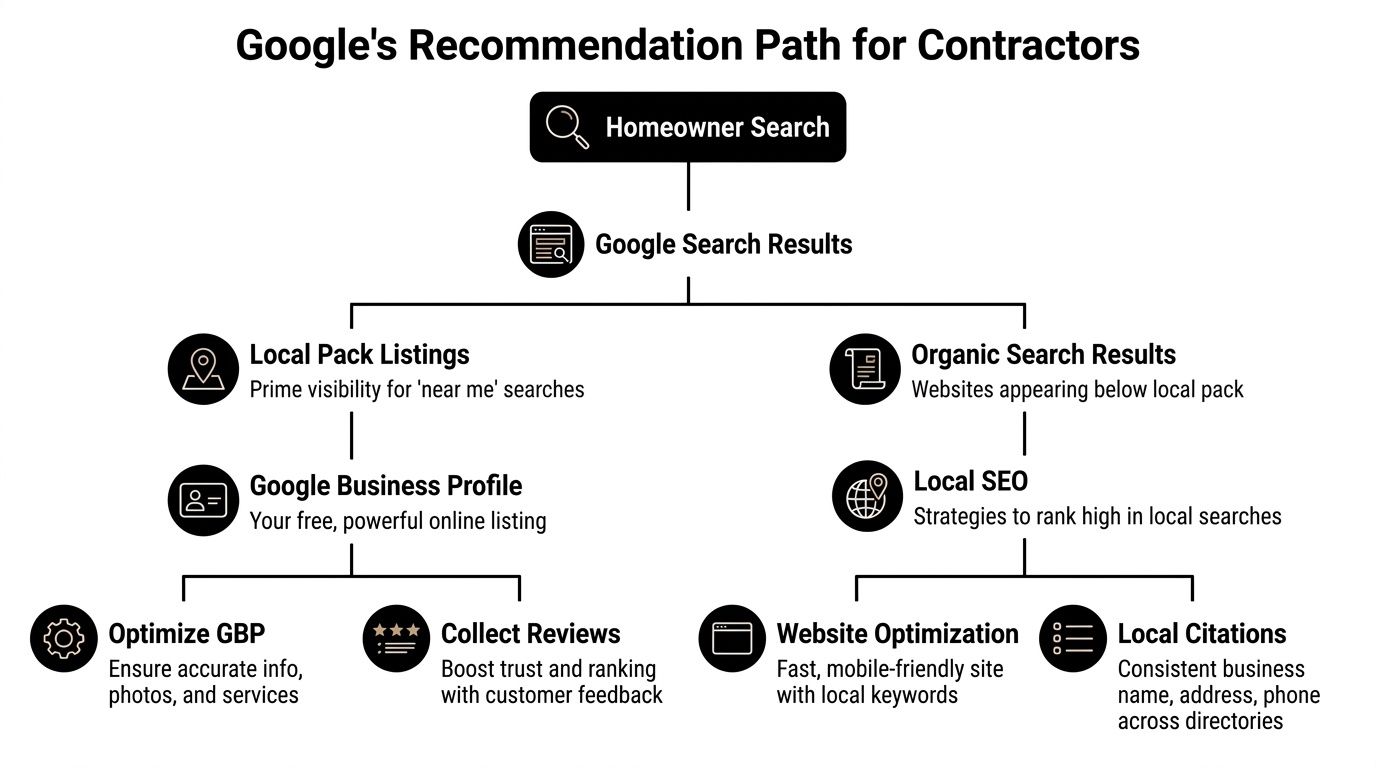
Think of Google like the new phone book
Google is trying to answer one simple question for the homeowner. “Who looks real, relevant, and nearby?”
You help Google answer that by making your business details consistent, keeping your profile active, and showing proof of real work. If your business name is written one way on your website, another way on a directory, and your phone number is outdated somewhere else, you’re making Google guess. Google hates guessing.
If you want a practical starting point, this guide on Google Business Profile for contractors lays out the core pieces clearly.
Do the three jobs that matter most
Most contractors overcomplicate local SEO. Start here.
Get your business info straight
Your name, address, phone number, service areas, and hours should match everywhere they appear online. No shortcuts. No old tracking numbers floating around on forgotten listings.
Ask for reviews every single time
Happy customers are your sales team. Don’t “hope” they leave a review. Ask while the job is fresh and the customer is excited. Then respond to every review so Google sees activity and homeowners see professionalism.
Post finished project photos
Upload real photos, not stock junk. Kitchens, baths, additions, exteriors, details, before-and-after shots. Homeowners want proof. Google wants freshness.
Here’s the timeline most contractors need to hear so they stop quitting too early. LocalBizGuru says that in months 3 to 6 of focused local SEO, contractors should expect 3 to 5 leads per month from organic search, and by month 12 the target is a top-3 Google Maps ranking with 20 to 30% monthly growth in organic traffic.
Good local SEO feels slow at first. Then it starts stacking wins on top of wins.
One more thing matters here. Don’t target broad phrases just because they sound important. You need local phrases with buying intent. If you want help choosing those phrases, this breakdown on how to find low competition keywords is worth your time.
The contractor who wins local search usually isn’t the fanciest company. It’s the one that sends Google the clearest signals.
Turn On the Faucet for Instant Qualified Leads
Monday morning. Two homeowners are ready to hire. One searches Google for your exact service in your exact town. The other clicks the first ad they see. If you want work now, paid search puts you in that second path fast. It also burns money fast when it is set up like a guessing game.
Buy qualified conversations
Contractors waste ad budget in the same predictable ways. They bid on broad keywords, send traffic to a generic page, then judge success by clicks. That approach fills reports, not calendars.
Set up Google Ads around the jobs you want. One service. One location. One clear next step.
“Kitchen remodeler Naperville” is better than “home remodeling.” “Bathroom renovation near me” beats “general contractor” if bathrooms are your profit center. The closer the search matches the job, the better the lead.
High intent usually shows up in the wording. Look for searches tied to urgency, scope, and fit. Then send each ad to a page built for that exact service. If you need a good model for that kind of page, study examples of a contractor website that acts like a salesperson, not a brochure, in this guide on how to turn your website into your best salesman.
If your market gets inquiries after hours, a simple lead generation chatbot can keep those prospects from disappearing while you are on a jobsite.
Stop paying for bad leads
Pay per lead platforms tempt contractors because they feel easy. Easy is not the same as profitable.
Analysts at I AM Builders report that 30 to 50% of leads from pay-per-lead platforms can be unqualified, and niche targeting, such as kitchens above $75K, can produce 2x ROI compared to chasing volume. That should change how you buy leads. Fewer, better-fit opportunities beat a pile of random names every time.
A lead source that sends renters, price shoppers, or jobs outside your area is not helping your business. It is taxing it.
Use a simple filter before you spend another dollar:
| Focus | What to do |
|---|---|
| Keywords | Bid on service-specific, location-specific searches with clear buying intent |
| Ad-to-page match | Send each ad to a landing page for that exact service, not your homepage |
| Lead screening | Filter for project type, service area, and minimum job fit before your team spends time |
| Lead source control | Dispute junk leads fast and cut platforms that keep sending bad-fit inquiries |
One more hard truth. Ads, SEO, and a polished website do not create a reliable lead engine by themselves. They create chances. If nobody answers fast, if missed calls sit there, or if form fills wait until tomorrow, you paid for attention and failed to convert it. The contractors who grow predictably treat ads as one part of a connected system, not a standalone tactic.
Clicks do not pay payroll. Booked appointments with the right homeowners do.
Make Your Website Your Best Salesperson
Most contractor websites are dead weight.
They look decent. They have a logo, a few service pages, maybe a paragraph about quality craftsmanship. But they don’t sell. They just sit there like an online brochure waiting for someone to do all the work.
Your website should act like your top salesperson. It should greet people, build trust fast, answer obvious questions, and make it easy to take the next step.
Your website has one job
The job is not to impress your peers.
The job is to turn a visitor into a call, form fill, or booked consultation. That’s it. Every page should push toward that outcome.
If you want a strong example of that mindset, this article on how to turn your website into your best salesman gets the point across well.
The three things every contractor site needs
A lot of website advice is fluff. These are the absolute necessities.
A phone number people can’t miss
Put it at the top of every page. Make it clickable on mobile. Don’t bury it in the footer like you’re hiding from customers.
A gallery that proves you do real work
Use high-quality project photos. Show the kind of jobs you want more of. If you want premium remodels, your gallery should not feel like a random camera roll.
Trust signals everywhere
Testimonials, reviews, warranty language, service areas, and clear process notes all reduce fear. Homeowners are not just buying a remodel. They’re buying peace of mind.
A good contractor website also needs clear service pages. One page for kitchens. One for baths. One for additions. One for outdoor living. Don’t mash everything together and expect the visitor to sort it out.
A homeowner should know what you do, where you work, and how to contact you within a few seconds.
Skip cute slogans. Skip long welcome paragraphs. Skip generic stock photos of people in hard hats pointing at clipboards.
Use plain words. Show real projects. Give people a simple next step.
Automate Your Follow-Up and Never Miss a Lead
A homeowner finds you on Google during lunch, calls while standing in their kitchen, and gets sent to voicemail. You call back two hours later. They already booked an estimate with the contractor who answered first.
That is how good leads die.
Getting traffic is only half the job. If SEO, Google Ads, and your website are feeding leads into a slow, manual follow-up process, your marketing system is leaking money.
According to the Siana Marketing report, phone calls from search are the highest-converting lead source for contractors at 40% conversion, and automated follow-up can raise conversions by another 35%. That should settle the debate. Speed matters, and manual follow-up is too unreliable to protect high-intent leads.
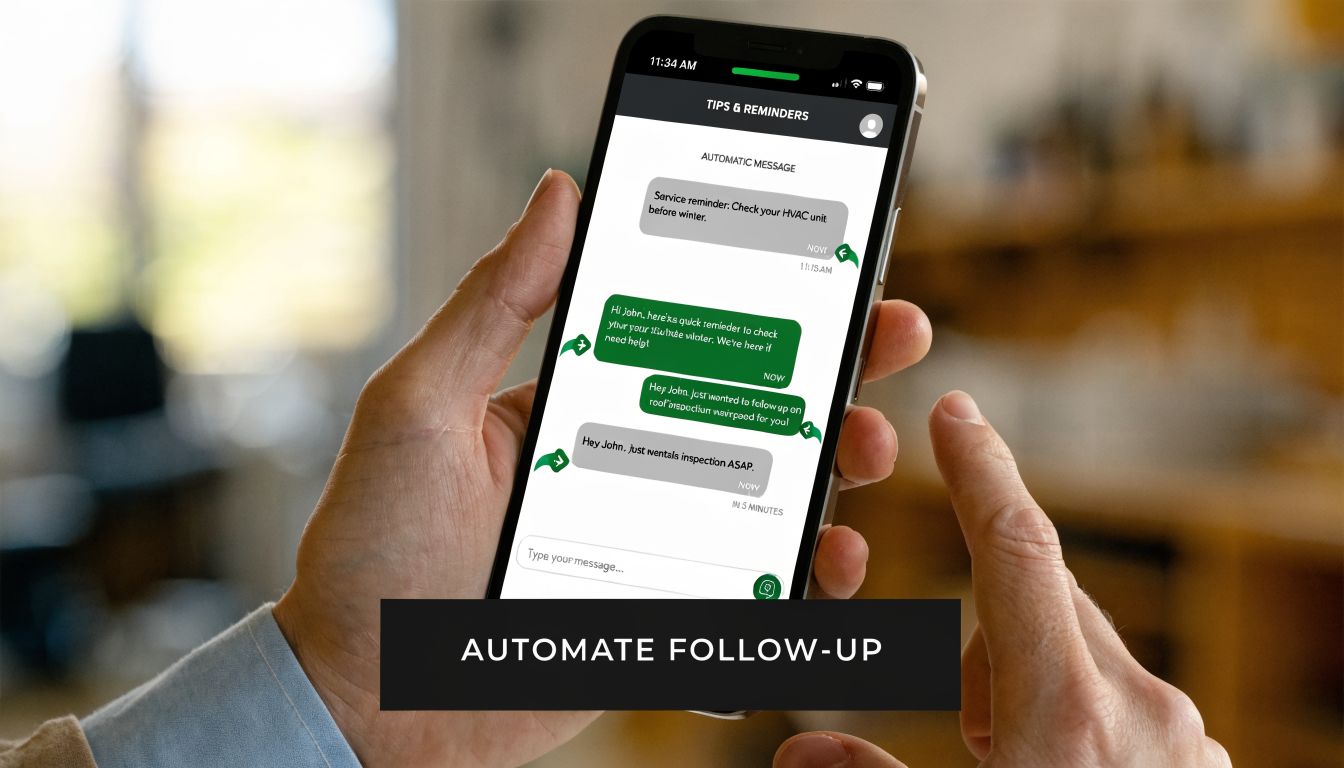
A CRM fixes the handoff. It replies the moment a call is missed, logs every inquiry, and keeps leads from disappearing into your inbox, call log, or a sticky note on the truck console.
Here’s the setup I recommend:
- Missed-call text-back: Send an immediate text that says you were tied up and will call soon.
- Instant form response: Confirm the message came through and set expectations for next steps.
- Lead tracking: Record every call, text, and form fill in one place.
- Pipeline stages: Sort leads by new, estimate scheduled, estimate sent, won, and lost.
- Task reminders: Prompt your team to follow up before the lead goes cold.
Keep the first message simple. “Sorry I missed your call. I’m with a customer right now. What project are you looking to get done?” works fine. Fast beats polished.
If you need a place to start, a contractor CRM with missed-call text-back and automated follow-up handles the mechanics. The brand matters less than the discipline. You need one system that catches every lead and pushes it to the next step without relying on memory.
Contractors love to blame lead quality. A lot of the time, response quality is the problem. Slow replies, no reply, and scattered follow-up kill deals before your sales process even starts.
If your current process depends on calling people back whenever the day calms down, you do not have a predictable lead generation system. You have a slot machine.
How to Know If Your Marketing Is Actually Working
Most marketing reports are built to confuse owners.
They talk about impressions, reach, clicks, engagement, and traffic spikes. That stuff can be useful in the background, but it doesn’t answer the only question that matters. Did your marketing produce profitable jobs?
You don’t need complicated dashboards to judge lead generation for contractors. You need a few blunt questions.
Track the questions that matter
Ask these every month:
- How much did I spend?
- How many qualified calls or form leads came in?
- How many of those turned into estimates?
- How many jobs did I win?
- What was the value of those jobs?
That’s the scoreboard.
ProjectMark reports that companies that excel at lead nurturing generate 50% more sales-ready leads at 33% lower cost, while 37% of marketers still struggle to measure ROI. Contractors should read that as a warning. If you can’t track the path from lead to sale, you can’t tell what’s working and what’s draining money.
Judge channels by revenue, not activity
A channel that sends fewer leads can still be better if those leads close into strong projects. A channel that sends lots of names can still be terrible if those names never become jobs.
Use a simple scorecard like this:
| Question | Why it matters |
|---|---|
| Was the lead qualified? | Stops you from counting junk as success |
| Did we respond fast? | Shows whether your process protected the opportunity |
| Did it book an estimate? | Tells you if the lead had real intent |
| Did it close? | Separates busywork from revenue |
| Was the job worth it? | Keeps your team focused on profitable work |
Closed-loop reporting matters because it ends the guessing. You stop saying, “I think Google is working,” and start saying, “These calls turned into these jobs.”
That’s how grown-up marketing works. Not by vibes. By outcomes.
If you want help building a connected system instead of chasing random tactics, Constructo Marketing works with remodelers on Local SEO, Google Ads, websites, and CRM follow-up so leads don’t leak out after the click. If your goal is more qualified homeowner demand and fewer wasted opportunities, they’re worth a look.