


You build great work. Your crews show up. Your projects look good. But the phone still goes quiet for stretches, and that makes growth feel random.
That’s where most construction owners get stuck. They think they have a lead problem, so they try a few Facebook posts, boost a photo, maybe buy some ads, then wonder why nothing changes. The problem is usually simpler. You don’t have a system. You have scattered pieces.
Digital marketing for construction companies works when it acts like a job site plan. Every part has a role. Google gets people to find you. Your website helps them trust you. Your follow-up process helps you win the job. If one piece is missing, the whole thing gets sloppy.
Table of Contents
- Why Your Next Big Project Will Come From Google
- Your Digital Job Site The Four Must-Have Tools
- Ranking on Google Where High-Value Clients Are Looking
- Winning Jobs Now With Smart Google Ads
- Building a Website That Sells Not Just Sits There
- The System That Turns Leads Into Jobs
- Your First 90 Days A Simple Action Plan
Why Your Next Big Project Will Come From Google
A lot of remodelers still run the business like this. Finish a job. Ask for referrals. Wait. Hope somebody’s neighbor needs a kitchen, bath, roof, or addition.
That used to work well enough. Now it puts your pipeline in someone else’s hands.
Over 90% of homeowners and commercial clients now begin their search for a contractor online, which means contractors without strong search visibility are invisible to nine out of ten potential clients according to IT Vibes on digital marketing costs for construction.
That one fact should change how you think about marketing. Your next good client probably isn’t waiting for a friend to mention your name. They’re typing a problem into Google right now.
What that means in plain English
If someone wants a major remodel, they usually start with a search like this:
- Kitchen remodeler near me: They want options nearby.
- Bathroom renovation cost in my city: They’re comparing serious providers.
- Home addition contractor: They’re looking for someone they can trust with a large project.
If your company doesn’t show up, you don’t even get a chance to compete.
Your workmanship can be excellent and still lose to a weaker competitor who simply shows up first online.
That’s why your Google Business Profile for contractors matters so much. It’s not a side task. It’s part of sales.
Stop treating digital as optional
Some owners hear “digital marketing” and think they need to become tech people. You don’t. You need the online version of what already works in the field.
You already understand visibility. A clean truck wrap, a sharp yard sign, a good referral, a solid reputation. Google is the same game in a different place. It’s where trust gets checked first.
Here’s my blunt advice. If you want steadier leads for larger jobs, stop waiting for word of mouth to carry the whole load. Keep referrals. They’re valuable. But build a pipeline you control.
Your Digital Job Site The Four Must-Have Tools
Think of your online presence like a job site. You wouldn’t show up with only a hammer and expect to frame a whole house. Same problem here. Most contractors lean on one thing and ignore the rest.
You need four tools working together.
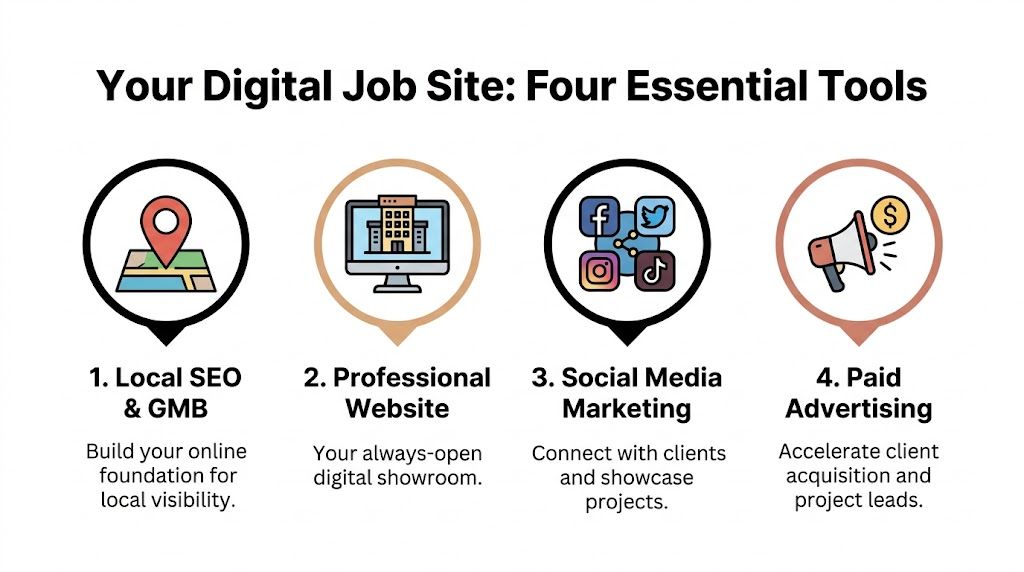
Tool one is your digital yard sign
Your Google Business Profile is the thing people see before they know you. It shows your reviews, photos, service area, hours, and phone number. It helps you appear on Google Maps and in local search results.
If this profile is half-filled-out or outdated, you look sloppy before anyone calls.
Tool two is your local reputation
Local SEO helps Google trust that you serve a real area and do real work there. This is how you show up when someone searches for a contractor in your town.
It includes things like:
- Consistent business info: Your name, address, and phone number need to match across directories.
- Service pages by area: You need pages for the places you want to work.
- Real project proof: Photos, reviews, and clear service descriptions help Google connect your company to actual work.
Local SEO is slower than ads, but it keeps paying off.
Tool three is your express lane
Google Ads gets you in front of people who are ready now. Good ads target buyers with high intent. Bad ads waste money on clicks from people who were never going to hire you.
This channel works best when you want leads soon, not someday.
Practical rule: Use ads to capture demand that already exists. Don’t use ads to make strangers care.
Tool four is your digital showroom
Your website is where people decide if you’re legitimate. If your site looks dated, loads poorly, or makes it hard to contact you, you lose trust fast.
A good website should do what a clean showroom does in person:
| Tool | Simple job |
|---|---|
| Google Business Profile | Gets you seen locally |
| Local SEO | Builds long-term visibility |
| Google Ads | Brings in fast demand |
| Website | Turns interest into inquiries |
Most contractors don’t need more tactics
They need fewer disconnected parts.
You don’t need fifteen channels. You need a simple setup where each part does its job. One business can use a provider like Constructo Marketing for integrated local SEO, paid ads, websites, and CRM automation. Another can split those tasks across different vendors. Either way, the rule is the same. Build one system, not a pile of random marketing activities.
Ranking on Google Where High-Value Clients Are Looking
Google works a lot like a librarian. A good librarian doesn’t hand out random books. They point people to the source that looks most reliable for the exact question being asked.
That’s what Google does for local contractors.
If you want the short version of What is Search Engine Optimization (SEO), consider it this way: SEO is the work that helps Google believe you’re the right answer for a local search.
Why local search matters more than broad traffic
For remodelers, broad traffic is nice, but local buyer intent is what pays the bills. Integrating Local SEO with Google Business Profile optimization can make high-intent local searches convert at 2-5x higher rates. Remodelers who reach a top-3 Map Pack position can generate 15-25 qualified leads per month per market, and 28-45% of local “near me” searches can lead to a direct call or form submission according to Thrive Agency’s construction digital marketing benchmarks.
That’s why “local famous” beats “internet famous.” You don’t need attention from the whole country. You need trust in the towns you serve.
How you build trust with Google
Google looks for signs that your business is real, relevant, and dependable. In marketing language, that often gets called E-E-A-T, which stands for Experience, Expertise, Authoritativeness, and Trustworthiness.
Here’s what that looks like in contractor language:
- Experience: Show completed work with real photos.
- Expertise: Write clear service pages that explain what you do.
- Authoritativeness: Get consistent mentions and reviews across the web.
- Trustworthiness: Keep your contact details accurate everywhere.
The actions that move the needle
A lot of owners overcomplicate this. Don’t.
Start here:
Fix your Google Business Profile
Add your correct services, service area, phone number, hours, and job photos.Post fresh project photos often
Kitchens, baths, additions, roofs, outdoor living projects. Show finished work people want.Ask for reviews after good jobs
Not months later. Right after the client is happy.Build pages for your service areas
One generic page won’t carry multiple towns well.Make your business info match everywhere
If your name or phone changes from site to site, Google gets mixed signals.
If Google sees mixed information, weak photos, and no recent activity, it has no reason to recommend you over the contractor down the street.
The Map Pack is valuable because it catches people at the exact moment they’re ready to reach out. That’s not branding fluff. That’s buying intent.
Winning Jobs Now With Smart Google Ads
SEO is a net. It helps you catch demand over time.
Google Ads is spearfishing. You aim at the exact search, in the exact area, when the exact buyer is looking.
That’s why I like ads for construction companies that want leads now. But only when the setup is tight. Loose campaigns burn cash fast.
The part most contractors miss
A lot of owners think Google Ads is just a bidding war. It isn’t. Google also judges how useful and relevant your ad is.
For construction firms, Google Ads Quality Score can lower cost-per-click by up to 50%. Campaigns using before-and-after display ads achieve a 2.1x higher click-through rate because visuals trigger homeowner decision-making in 70% of renovation searches based on Findable Digital Marketing’s Google Ads breakdown for construction.
Simple version. If people click your ad and like what they see after the click, Google often rewards you. If your ad is sloppy and your landing page is weak, Google makes you pay more.
What a smart campaign looks like
A good construction ad account usually has tight targeting and clear intent. Not broad junk.
Focus on searches like these:
- High-intent service searches: “kitchen remodel contractor [city]”
- Budget-aware searches: “bathroom renovation cost [city]”
- Project-specific searches: “home addition contractor [city]”
Then match each ad to a landing page that speaks to that exact search.
What to do and what to avoid
| Do this | Avoid this |
|---|---|
| Use before-and-after visuals | Use bland stock images |
| Send clicks to a focused service page | Send everyone to the homepage |
| Target specific service areas | Target huge vague regions |
| Track calls and forms | Guess which ads worked |
If you want a technical look at tools that help manage and connect campaign data, this overview of google ads mcp is useful.
The ad is only the promise. The landing page is where you prove it.
My recommendation for remodelers
Start with a narrow campaign. One service. One area. One clear offer.
Don’t advertise everything at once. Don’t target every town you’ve ever worked in. Don’t send paid traffic to a page that says nothing useful.
A small, sharp campaign beats a wide, messy one every time. Especially when you’re trying to attract higher-value homeowners instead of bargain shoppers.
Building a Website That Sells Not Just Sits There
Most contractor websites are brochures. They say who you are, show a few photos, and then just sit there doing nothing.
That’s a waste.
Your website should work like a showroom with a salesperson inside it. A visitor should quickly see your work, understand what you do, trust your process, and know the next step.
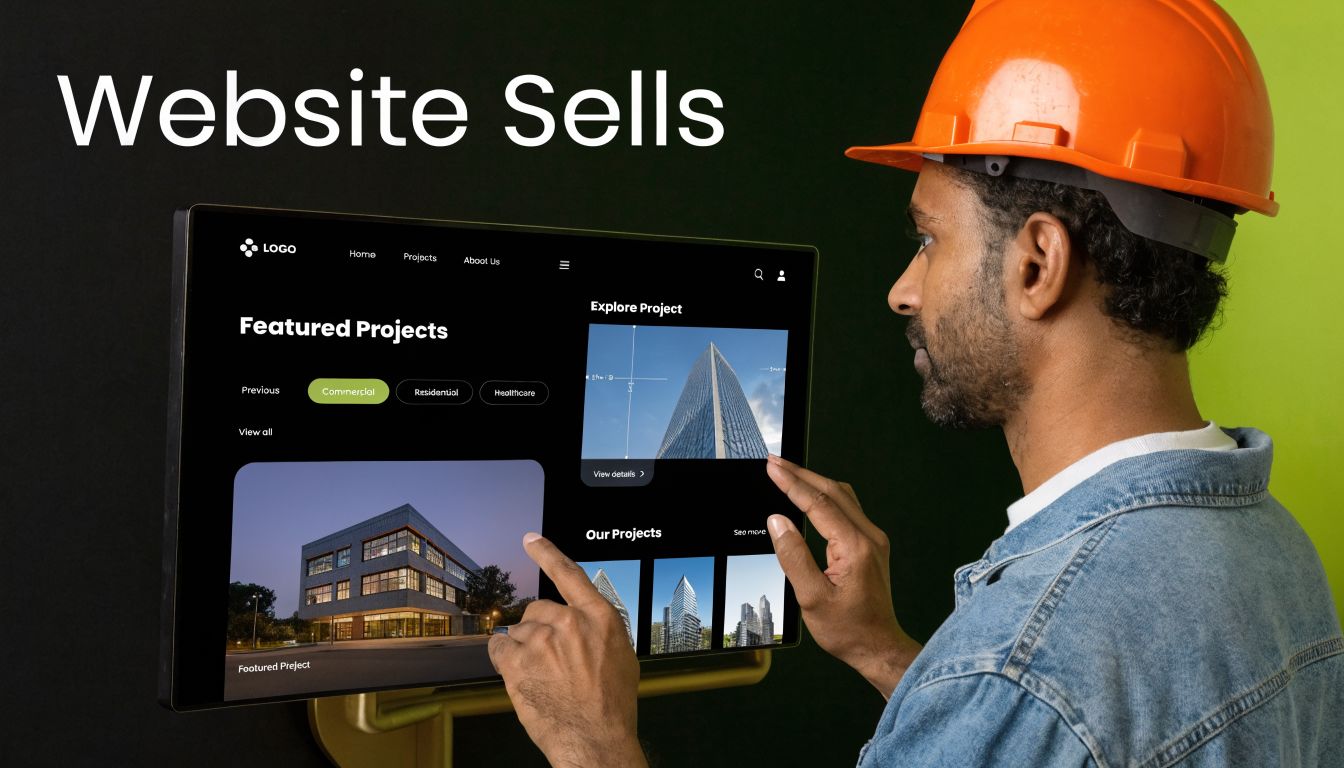
A website has one main job
Its job is not to exist. Its job is to help a serious prospect contact you with confidence.
That means your website needs to answer basic buyer questions fast:
- What do you do
- Where do you work
- What kind of projects do you take on
- Why should I trust you
- How do I contact you
If those answers are hard to find, people leave.
What a strong contractor site includes
A better site feels less like a flyer and more like a guided walkthrough.
Here’s the checklist I use:
- Clear service pages: Don’t lump everything into one vague page.
- Real project galleries: Show actual work, not filler.
- Simple calls to action: “Schedule a consultation” beats vague contact language.
- Trust builders: Reviews, credentials, process details, and location signals matter.
- Easy mobile experience: Many prospects will visit on their phone first.
If you want a deeper breakdown, this guide on how to turn your website into your best salesman is worth reading.
The fast test
Open your homepage on your phone and ask three questions:
- Can I tell what this company does in a few seconds?
- Can I see strong proof of work without digging?
- Can I contact them without hunting around?
If the answer is no to any of those, the site needs work.
A beautiful website that doesn’t guide people to call, book, or submit a form is just expensive decoration.
Common mistakes that kill conversions
Some are obvious. Some aren’t.
- Too much text up front: People scan first.
- Weak photos: If your work is premium, the images need to look premium.
- No local relevance: Visitors want to know you serve their area.
- Confusing navigation: Don’t make people play hide-and-seek.
Your website doesn’t need fancy tricks. It needs clarity. Good photos. Strong proof. Clear buttons. That’s what turns traffic into leads.
The System That Turns Leads Into Jobs
This is the part most marketing guides get wrong. They act like the win is getting the lead.
It isn’t.
The win is turning the lead into a conversation, then a consultation, then a signed job. If your follow-up is weak, your marketing can look broken even when it’s working.
The hidden leak in most construction companies
Busy owners miss calls. Estimators mean to follow up later. Office staff gets buried. A good lead comes in during a job walk, and no one replies fast enough.
While most marketing guides focus on lead generation, they ignore the fact that 70-80% of leads in home services can be lost due to poor follow-up. Integrating a CRM with automation, like a missed-call text-back feature, addresses this critical gap according to SharpShell Digital’s overview of digital foundations for small construction companies.
That should hit hard, because it means your problem may not be lead quantity. It may be lead handling.
Think of CRM as a digital receptionist
A good CRM doesn’t replace your sales process. It catches what humans drop.
It can help with:
- Missed-call text-back: If you miss the phone, the system answers right away.
- Lead tracking: Every inquiry goes into one place.
- Follow-up reminders: Nobody has to remember everything in their head.
- Pipeline visibility: You can see who is cold, warm, booked, or dead.
That’s why I tell contractors to stop asking only, “How do I get more leads?” Start asking, “What happens in the first five minutes after a lead comes in?”
Fast response beats good intentions
A lot of owners say, “I always call people back.” Maybe you do. But do you do it every time, when the crew is behind, when you’re driving, when the office is slammed, when the lead comes in after hours?
That’s where systems win.
| Lead stage | What should happen |
|---|---|
| New call or form | Immediate confirmation |
| Missed call | Automatic text-back |
| No response yet | Follow-up reminder |
| Consultation booked | Calendar and contact stored |
| Estimate sent | Ongoing follow-up until closed or lost |
If you’re still managing this with sticky notes, inbox chaos, and memory, you’re leaking jobs.
For a practical look at the top-of-funnel side of the process, this article on lead generation for contractors connects well with the follow-up side.
Marketing gets attention. Systems protect it.
Your First 90 Days A Simple Action Plan
You don’t need to do everything this week. You need to do the right things in the right order.
The first ninety days should be about building the base, launching one traffic source, and tightening your follow-up.
Month one build the foundation
Start with the assets you own.
Clean up your Google Business Profile. Fix your website basics. Make sure your phone number, service area, and core services are clear. Add real project photos.
Then set up a CRM or lead tracking system. If leads come in and nobody knows what happened next, stop there and fix that before you push harder on traffic.
Month two add controlled demand
Once the basics are in place, launch a small Google Ads campaign around one service in one target area. Keep it narrow.
At the same time, start asking happy clients for reviews and keep adding fresh project photos. That helps your local visibility and gives paid traffic better proof when people click through.
Month three tighten what works
Look at the leads. Not vanity metrics. Real leads.
Which service is producing calls? Which landing page gets forms? Which leads answer the phone and book? Keep the parts that move jobs forward and cut the parts that only create noise.
Sample 90-Day Marketing Launch Plan
| Phase | Focus | Key Actions | Sample Monthly Budget Allocation |
|---|---|---|---|
| Foundation | Local presence and conversion basics | Set up or fix Google Business Profile, update website messaging, add project photos, install lead tracking or CRM | Website and local SEO focused spend |
| Acceleration | Immediate lead flow | Launch a small Google Ads campaign, gather reviews, improve service pages, track calls and forms | Paid ads plus landing page improvements |
| Optimization | Better lead handling and refinement | Review lead quality, adjust ads, improve follow-up automations, sharpen calls to action | Keep spend on winning channels and reduce waste |
Keep your budget simple
Tie your budget to your revenue goals and margins. If you want bigger jobs, you need enough spend to be visible and enough process to handle what comes in.
My advice is simple:
- Fund the foundation first: Don’t drive traffic to a weak website or broken follow-up system.
- Start narrow: One service and one area is easier to control.
- Measure outcomes: Count calls, form submissions, appointments, and closed jobs.
- Stay consistent: Don’t quit because one channel didn’t magically work in a week.
You don’t need a giant marketing machine. You need a clean system that brings in demand, proves trust, and follows up fast.
If you want help building that full system, Constructo Marketing works with remodelers on local SEO, Google Ads, websites, and CRM automation designed to keep leads from slipping through the cracks.