
Published Apr 15, 2026
You finish a beautiful remodel. The cabinets line up perfectly. The tile is dead straight. The client is thrilled.
Then you open your bank account and think, “Where did the money go?”
That problem eats up a lot of good remodelers. You know how to build. You know how to solve jobsite problems. But the business side feels muddy, and muddy numbers kill strong companies.
Construction profit margin is the number that tells the truth. Not your sales. Not how busy you are. Not how many leads came in. Profit margin tells you what you kept after the dust settled.
If your projects look high-end but your checking account looks tired, your business has leaks. Some leaks come from estimating. Some come from labor and materials. Some come from sloppy change orders. Some come from bad leads that waste your time before a job even starts.
You don’t need a finance degree to fix this. You need simple math, cleaner systems, and a habit of watching the right numbers.
Table of Contents
- Why Your Amazing Projects Don't Build Your Bank Account
- Thinking About Profit Like a Pizza
- The Simple Math That Determines Your Take-Home Pay
- Finding the Leaks Where Your Profit Disappears
- How to Plug the Leaks and Boost Your Bottom Line
- Building Your Simple Profitability Dashboard
- Frequently Asked Questions About Profit Margin
Why Your Amazing Projects Don't Build Your Bank Account
You finish a beautiful remodel, the client is thrilled, the crew worked hard, and the photos look portfolio-worthy. Then you check the bank balance and wonder where the money went.
That gap is the problem.
You can build excellent projects and still run a business that bleeds profit through bad leads, weak estimating, sloppy change orders, and poor follow-up. Skilled remodelers get trapped here all the time. The work is solid. The business side is loose.

Busy is not the same as profitable
A packed schedule can fool you.
You can stay buried in estimates, site visits, client calls, and production issues while your margin gets shaved down from every direction. Low-quality leads waste sales time. Slow follow-up lets good prospects go cold. Poor job documentation turns change orders into awkward arguments instead of signed revenue. By the time the project wraps, you did plenty of work and kept too little of the money.
That is not a production problem alone. It is a systems problem.
Your bank account only sees what survives
Revenue is the top line. Your bank account cares about what survives the mess between signed contract and final payment.
Here is what usually drains profit in a remodeling company:
- Leads that were never a fit
- Estimates built on rough guesses instead of clean numbers
- Change orders discussed in the field but not approved fast
- Client communication scattered across texts, email, and memory
- Follow-up that depends on you remembering everything
- Jobs sold at a price that looked fine until overhead showed up
Each one feels small. Together, they eat the profit you thought the project would produce.
Great craftsmanship gets you compliments. Clean systems get you paid.
What healthy should look like
Your company needs a clear profit target before you bid, not after the job goes sideways.
A healthy remodeling business leaves enough margin to cover overhead, absorb surprises, and still put cash back into the company. If your projects only keep you busy, you built yourself a job. If they consistently leave money behind, you built a business.
That is why generic financial advice falls short. You do not fix margin only in a spreadsheet. You fix it by tightening the whole chain from lead to closeout.
Constructo addresses that chain directly. It helps you bring in better-fit leads, track every conversation in one CRM, tighten follow-up, and keep change orders and client communication from slipping through the cracks. That means fewer leaks before the job starts, fewer leaks while it runs, and more of the contract value turning into actual profit.
Thinking About Profit Like a Pizza
Forget accounting words for a minute.
Let’s make this stupid simple. Profit works like a pizza.
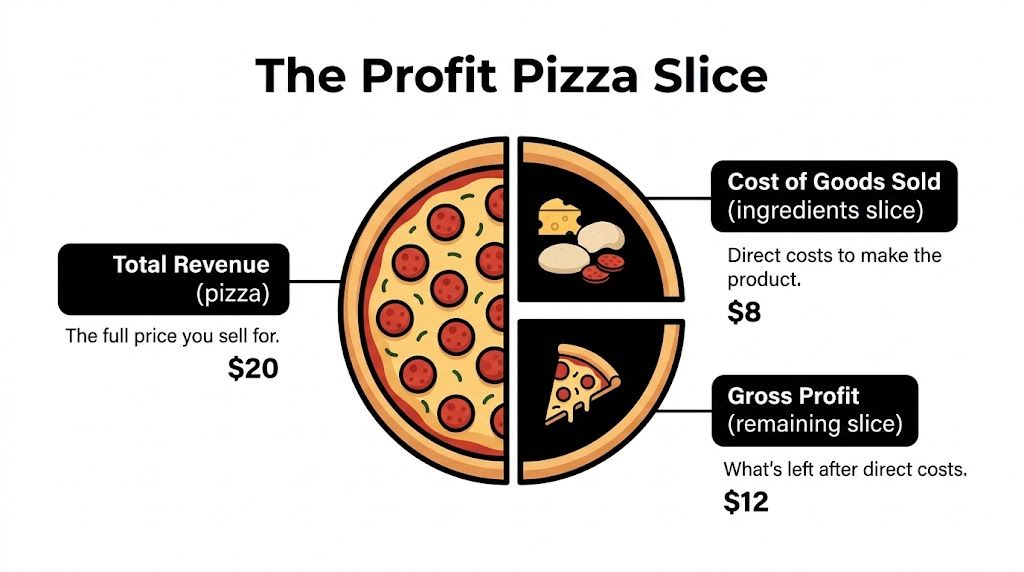
The whole pizza is revenue
You sell a pizza for $20.
That $20 is revenue. It’s the full amount the customer paid.
In your remodeling business, revenue is the full contract price. If you sell a kitchen remodel, the contract total is the whole pizza.
The ingredients are direct costs
Now take out the cheese, dough, sauce, and pepperoni. Those ingredients cost $8.
That $8 is your direct cost. In remodeling, direct costs are job costs tied to that one project. Think lumber, cabinets, tile, labor on the job, and subcontractor costs.
You can’t build without them, just like the pizza shop can’t make pizza without ingredients.
What’s left is gross profit
If the pizza sold for $20 and the ingredients cost $8, you’ve got $12 left.
That $12 is gross profit.
Gross profit tells you whether the job itself was priced well enough. It does not tell you whether your company made good money overall. It only tells you whether the project had enough meat on the bone before overhead hit.
Then overhead takes its bite
The pizza shop still has to pay for the oven, lights, rent, and the person answering the phone. Say that costs $7 for that pizza.
That’s overhead.
In your company, overhead includes the stuff that keeps the machine running. Office admin, estimating time, software, insurance, vehicles, phones, and all the other expenses that don’t live inside one job but absolutely must be paid.
Net profit is what you actually keep
You started with $20.
You spent $8 on ingredients.
You spent $7 on overhead.
You keep $5.
That $5 is net profit. That’s the money that stays in your pocket.
Practical rule: Gross profit shows whether the job was sold right. Net profit shows whether the business is run right.
Operating profit tells you how your core business is behaving
There’s one more slice that matters. Operating profit.
According to ServiceTitan’s explanation of construction profit margin, operating profit margins in construction average 10-15%, and the formula is (Revenue – Direct Costs – Overhead) / Revenue. That number tells you how efficient your day-to-day operation is before taxes and interest.
Here’s the plain-English version:
- Revenue is the whole pizza.
- Direct costs are the ingredients.
- Overhead is the oven, lights, office, and delivery driver.
- Operating profit shows whether the shop itself is working.
- Net profit shows what you really kept after everything.
If you don’t separate those slices, you’ll keep lying to yourself with busy work and weak cash.
The Simple Math That Determines Your Take-Home Pay
A lot of remodelers work their tails off on a $100,000 job and still feel broke at the end of it. The reason is simple. They know the project total, but they do not know what they kept.
You fix that with four numbers.
The formulas you need on every job
| Metric | Formula |
|---|---|
| Gross Profit | Revenue – Direct Costs |
| Gross Profit Margin | (Gross Profit / Revenue) × 100 |
| Net Profit | Revenue – Total Costs |
| Net Profit Margin | (Net Profit / Revenue) × 100 |
Memorize them. Put them in your spreadsheet. Review them before you price the job, while the job is running, and after the final invoice is paid.
A real remodeling example
Take a $100,000 kitchen remodel.
Your field labor, materials, and subs cost $80,000. That leaves $20,000 in gross profit, or a 20% gross margin.
Now subtract the overhead tied to keeping your company open. Office payroll, estimating time, vehicles, software, insurance, sales follow-up, callbacks, and all the other costs that do not show up neatly on one job. If that share of overhead is $12,000, your net profit drops to $8,000.
Your net profit margin is 8%.
That is the number that matters. It tells you whether the job fed your business or just kept everybody busy.
What this math is really telling you
A decent gross margin with a weak net margin means the problem is not just production. The business side is bleeding money.
Poor lead quality burns estimating hours before a contract is even signed. Slow follow-up lets good prospects go cold. Messy change orders turn extra work into free work. Bad job data forces you to guess instead of price with confidence. Those are not random headaches. They hit your margin directly.
That is why clean systems matter. Your marketing, sales pipeline, job notes, and change order process should all connect. If they do not, profit slips out through the cracks long before you look at the P&L.
If you need a simple spreadsheet setup, this guide on the Excel formula for gross margin is a practical starting point.
If you want to pressure-test your numbers before sending a bid, use this construction pricing calculator for remodelers.
Use the math to make decisions, not excuses
As noted earlier, healthy remodelers protect enough gross margin to cover overhead and still leave a real net profit at the end. If your net margin stays skinny, stop blaming the market first. Fix your pricing process, fix your follow-up, fix your change orders, and fix the way leads and job data move through your business.
If you cannot calculate your margin in under a minute, you are still bidding on hope.
Finding the Leaks Where Your Profit Disappears
Profit doesn’t usually vanish in one dramatic disaster.
It leaks out in drips. A little on the estimate. A little in the field. A little in the office. A little in sales. By the end of the job, your bucket is half empty.

Leak one is soft estimating
A weak estimate is like starting a race with your shoelaces tied together.
You don’t lose because the crew failed. You lose because the job was underpriced before the first hammer swung.
This happens when you guess labor, forget supervision time, understate material waste, or price a custom project like it’s routine. Then the field team gets blamed for a math problem created in the office.
Leak two is sloppy change orders
This one is brutal because it hides in plain sight.
A client asks for a few extras. Move this wall outlet. Upgrade that finish. Add a little framing. Shift a cabinet detail. None of it feels huge in the moment, so the team just handles it.
Then the job ends and the profit is gone.
According to Contractor Foreman’s breakdown of construction profit leaks, one of the costliest leaks is undocumented scope changes, and contractors often miss billing for 10-20% of potential revenue from small client add-ons. That same source says those missed changes can turn what should have been a 5-7% margin booster into a loss.
That’s not a paperwork problem. That’s a profit problem.
Small unbilled changes are not “good customer service.” They are unpaid labor wearing a polite shirt.
Leak three is cost pressure you failed to recover
Material and labor costs move. Your contract price often doesn’t.
When costs rise after the bid and you don’t have a process for protecting margin, you absorb the hit. The customer still gets the project. Your business takes the bruise.
That’s why fixed-price remodeling needs discipline. If you don’t track cost changes fast, you’ll keep winning work that yields diminishing returns every month.
Leak four is bad leads
This leak gets ignored because owners don’t see it on a job-cost report.
You spend time answering calls, visiting homes, writing estimates, and following up with people who were never serious, never qualified, or only wanted the cheapest number. That burns your calendar and your sales energy.
The actual damage is indirect. Bad leads clog your pipeline, distract your estimator, slow response time to better prospects, and push you into price-shopping conversations where your craftsmanship doesn’t matter.
If you want a practical look at what marketing should cost and how it affects your business model, this guide on how much a remodeling company should spend on marketing and what it really costs is worth reviewing.
Leak five is poor follow-up
A good lead comes in. Nobody calls back fast enough. Or the office forgets. Or the homeowner goes cold because nobody stayed in touch.
That lost opportunity doesn’t show up as an expense line, but it hurts your margin anyway. When your close rate drops, your customer acquisition cost per sold job gets uglier. You spend the same effort and keep less return.
How to Plug the Leaks and Boost Your Bottom Line
A lot of remodelers hit a brutal pattern. The schedule is full, the crew is busy, clients are saying yes, and the bank account still feels tight.
That problem is rarely about effort. It is usually a broken business system. Money leaks out before you ever get paid well for the craftsmanship.
Fix your estimating process first
Bad estimates poison everything downstream. If the number is wrong at the start, production spends the whole job trying to outrun a mistake.
Build every estimate from actual job history. Break out labor, materials, subcontractors, permits, and overhead. Add markup on purpose. If a job has design gaps, site uncertainty, or picky finish details, price that risk instead of hoping it goes away.
Hope is not a pricing strategy.
Turn change orders into a controlled process
Messy change orders wreck margin because they hit from two directions. You do extra work without billing enough, and your team loses time sorting out who approved what.
Fix it with one rule. No extra work starts until the scope, price, and approval are documented.
That rule needs to live in your sales process, your production process, and your CRM. If your office tracks one version, the PM tracks another, and the client has a third version buried in text messages, you are inviting margin loss. One system should hold the lead record, proposal, change requests, approvals, and job notes so nothing slips between the cracks.
Raise prices for the right jobs
Some owners know they are underpriced. They keep stalling because they are afraid the phone will stop ringing.
That fear costs more than a price increase ever will.
The average net profit margin for single-family builders rose to 8.7% in 2023, the second-highest level in over three decades, according to NAHB’s 2025 announcement on builder financial performance. Strong operators still protect profit in a tough market. You can too, but only if you stop treating every prospect like a job you must win.
Get stricter about lead quality
A weak lead costs money long before you ever sign a contract. Your estimator burns hours. Your sales process slows down. Good prospects wait too long for a reply while bargain shoppers eat up your calendar.
That is a margin problem, not just a marketing problem.
Your marketing should bring in jobs that fit your price point, service area, and project type. Your CRM should screen out the rest fast. If you want a practical way to track that, use a remodeling marketing scorecard for lead quality, close rate, and pipeline health. It helps you spot whether your lead flow is feeding profit or just feeding activity.
Build one follow-up machine
Follow-up should work like a jobsite schedule. Clear next steps. Clear owners. Clear deadlines.
Use a CRM and make it the command center. Every inquiry gets logged. Every lead gets qualified. Every estimate gets follow-up tasks until the answer is yes or no. Every active job gets change requests and approvals attached to the same record. That is how you fix the handoff problems that kill margin.
Here is the simple flow:
- New lead: Qualify budget, scope, location, and timeline.
- Qualified opportunity: Book the next conversation fast.
- Proposal sent: Schedule follow-up until the client decides.
- Job in production: Track changes, approvals, and client communication in one place.
- Job complete: Compare estimated profit to actual profit and fix the estimating gaps.
Constructo’s approach is key. Better marketing brings in better-fit leads. A connected CRM keeps those leads from going cold, keeps change orders organized, and gives you a clean record of what happened on the job. That closes the loop between sales, operations, and profit instead of treating them like separate problems.
If you want another practical outside perspective, this guide on how to improve profit margins offers useful business-side ideas that support this same mindset.
Building Your Simple Profitability Dashboard
Monday morning. The crews are busy, the phone rang all week, and the sales pipeline looks full. Then you check the bank account and wonder why all that activity still feels tight.
That is a dashboard problem.
You do not need a stack of reports. You need one clear scoreboard that shows whether the work coming in, the jobs going out, and the dollars left over line up.

The four numbers that matter most
Track four numbers first. If these are wrong, the rest is noise.
Estimated versus actual job cost
This shows whether your estimate was accurate or whether production chewed up the margin.Gross profit by job
This shows which projects were sold well and which ones were underpriced from day one.Net profit margin for the business
This shows what the company kept after overhead, callbacks, admin time, and the rest of the business burden.Lead status and close progress
This shows whether your pipeline is producing future profit or just giving you false hope.
What your dashboard should answer
A useful dashboard helps you answer a few blunt questions fast.
Are you winning the right jobs or just staying busy?
Are change orders getting approved and billed, or are they turning into free work?
Are leads moving to estimates, estimates moving to signed jobs, and signed jobs finishing at the margin you planned?
Is overhead staying in line with sales, or is the office eating what the field earns?
That last point matters more than owners like to admit. Plenty of remodelers blame pricing when the problem is sloppy follow-up, weak qualification, and poor job documentation. Bad leads waste estimating hours. Messy change orders delay billing. Both hit margin.
Set targets you will actually review
Your dashboard does not need fancy graphics. It needs targets you will check every month and act on every week.
Use broad target ranges that fit your business model, as noted earlier in this article. Then compare your actual numbers against your own plan. If your gross profit looks fine but net profit stays thin, overhead or sales waste is the problem. If your close rate looks healthy but actual job costs keep climbing past the estimate, the problem sits in production, scope control, or both.
Here is a simple monthly dashboard layout:
| KPI | What it tells you |
|---|---|
| Estimated vs actual cost | Whether pricing and production match reality |
| Gross profit per job | Whether each project was sold with enough room |
| Net profit margin | Whether the business keeps enough after overhead |
| Pipeline movement | Whether sales activity is turning into profitable work |
Keep this visible. Review it with the same discipline you bring to a jobsite schedule. A simple marketing scorecard for remodelers is a good model for keeping lead quality, pipeline movement, and performance in front of you.
Constructo’s value is simple. Better marketing brings in better-fit leads. A connected CRM ties those leads to estimates, change orders, job records, and final results. That gives you one place to spot where profit was made, where it leaked out, and what needs fixing next.
Frequently Asked Questions About Profit Margin
What’s the difference between margin and markup
They are not the same. Mixing them up will make you underprice work.
Margin is the percentage of the selling price that becomes profit.
Markup is the percentage added on top of cost to reach the selling price.
Simple version. Margin looks backward from the sale price. Markup looks forward from cost.
If you confuse them, you’ll think you priced a job for one result while your actual profit comes out thinner.
Margin is what you keep from the sale. Markup is what you add to the cost.
How do I figure out my overhead
Add up the costs required to run your company that are not direct job costs.
That usually includes office payroll, rent, software, insurance, phones, vehicles, admin, and sales time. Once you know that total, you need a clean way to spread it across your jobs so every estimate carries its share of the company burden.
A lot of owners skip this because overhead feels fuzzy. Don’t skip it. If overhead isn’t inside your pricing, you’re paying for the business out of your own pocket.
What’s a good construction profit margin for a remodeler
It depends on your model, your discipline, and the kind of work you chase.
For residential remodelers, a healthy gross profit margin ranges from 18-25%, and average net profit margin lands between 6-8.7% after overhead, based on the Aladdin benchmark cited earlier. For specialized residential remodelers, the target can be higher when sales and overhead are controlled, as noted earlier in the article.
The bigger point is this. Stop comparing yourself to your busiest year. Compare yourself to clean numbers.
Should I ever take a lower-margin job
Yes, sometimes. But do it on purpose.
A lower-margin job can make sense if it gets you into a neighborhood you want, fills a strategic gap in the schedule, strengthens a trade relationship, or produces portfolio work that helps you sell better projects later.
The mistake is making low-margin work your default diet.
One lean job chosen on purpose is strategy.
A whole pipeline of lean jobs is a business problem.
Why do I feel broke even when sales look strong
Because sales don’t pay you. Net profit pays you.
You can have strong revenue and weak margin at the same time. That happens when estimating is soft, overhead is too high, leads are poor, follow-up is messy, or change orders aren’t controlled.
That feeling of “we’re busy but broke” usually means the business is producing activity instead of profit.
If you’re tired of building great projects without building a stronger business, talk to Constructo Marketing. They help remodelers create a tighter system around lead quality, follow-up, CRM visibility, and local demand generation so fewer opportunities slip through the cracks and more of your hard-earned revenue turns into real profit.