


Some weeks your phone won't stop ringing. Then a month later, you're staring at the schedule and wondering where the next good project is coming from. That's where many remodelers get stuck. Word of mouth is powerful, but it isn't predictable.
Pay per click advertising for contractors gives you a way to show up when homeowners are already looking for help. It's comparable to parking your truck at the busiest intersection in town, except that intersection is Google and the passersby are typing things like "kitchen remodeler near me" or "home addition contractor."
The part most contractors never get told is this. Getting the lead is only half the job. If that lead sits in your inbox while you're on a job site, you can lose it before you ever say hello. For bigger residential projects, the money is usually made or lost in the follow-up.
Table of Contents
- Why Smart Contractors Use PPC for Big Projects
- Your Game Plan Before You Spend a Dollar
- Building Your Ads Account Like a Pro
- Writing Ads and Building Pages That Get Leads
- Connecting Ads to Your Sales Process
- Making Your Ads Better Over Time
Why Smart Contractors Use PPC for Big Projects
A remodeling business doesn't grow on hope. It grows on booked jobs. PPC helps you get in front of homeowners who are already raising their hand and saying, "I need this now."
That's why Google matters so much here. Google had 98% of marketers using its PPC ads in 2023, and Google Ads can deliver up to a 200% return on investment, generate twice the website traffic of SEO, and capture 65% of clicks for commercial-intent keywords according to Quantumrun's PPC advertising analysis. If someone is searching with buying intent, paid search often gets the first shot.

PPC is a faucet not a mystery
SEO is valuable, but it takes time. PPC is different. You turn it on, and your ads can start appearing for the searches you choose.
For a contractor, that control matters. You can focus on kitchen remodels, bath remodels, additions, roofing, or outdoor living. You can limit ads to your service area. You can stop spending on work you don't want.
Practical rule: PPC works best when you use it to chase the jobs you actually want, not every possible click.
PPC advertising can be compared to fishing with a fish finder. Random marketing is tossing bait into a huge lake and hoping. PPC is seeing where the fish are schooling, then dropping your line right there.
A lot of owners also like PPC because it's measurable. You can connect clicks to calls, forms, and booked appointments instead of guessing which billboard, postcard, or sponsorship did what. If you want a broader primer on small business PPC success, that guide gives helpful background without getting too technical.
Better fit for high intent searches
Big projects don't come from random attention. They come from timing. A homeowner who types "kitchen remodel contractor near me" is much closer to action than someone who casually scrolls social media.
That's why pay per click advertising for contractors can feel so different from other channels. You're not interrupting someone. You're answering them.
If you want the rest of your marketing to support that same demand capture approach, this guide to a construction marketing strategy is a useful companion. PPC is strongest when it fits into a larger system, not when it stands alone.
Your Game Plan Before You Spend a Dollar
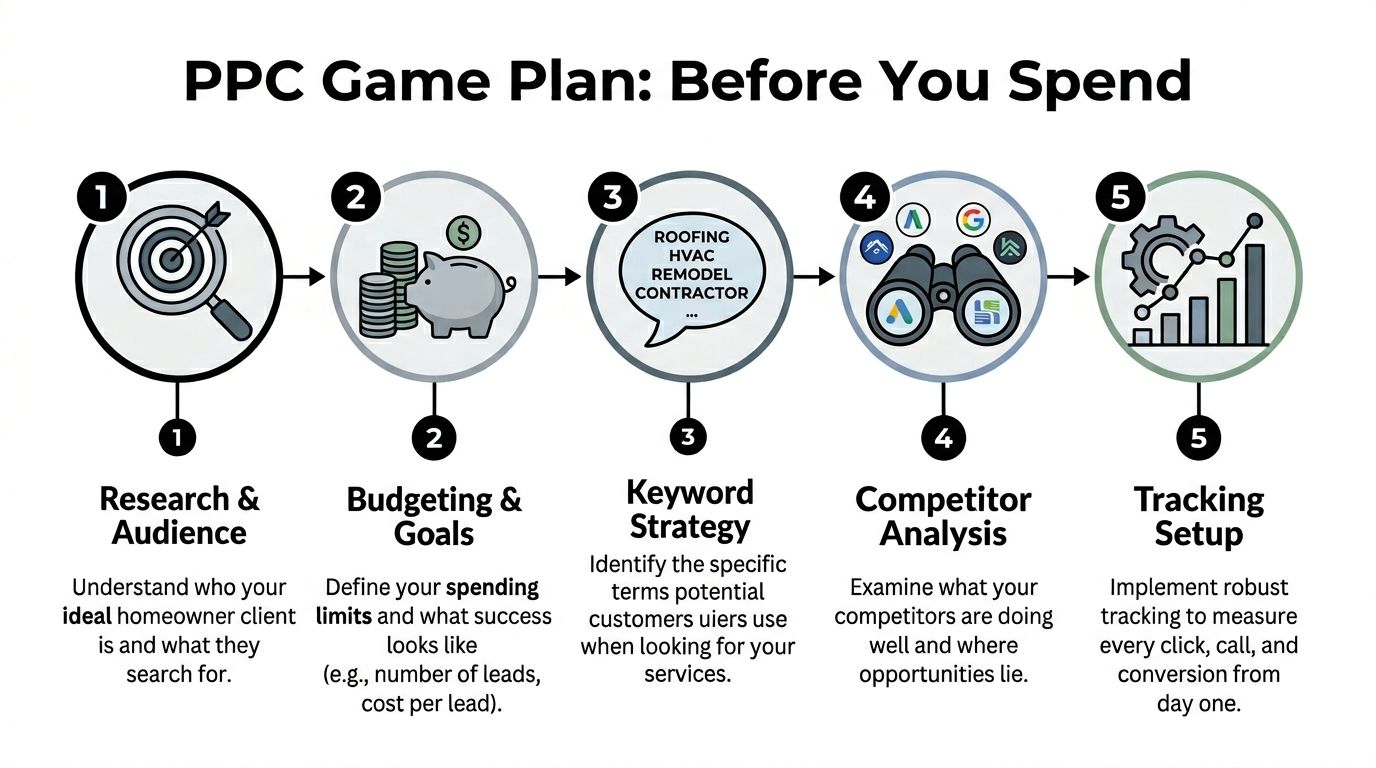
Starting Google Ads without a plan is like pouring a foundation without checking the measurements. Concrete is expensive. So are bad clicks.
Most contractors pick a number that feels safe, then hope it turns into jobs. That backwards approach is why so many campaigns wobble right out of the gate.
Start with jobs not budget
The cleaner way is to work backward from revenue. One verified example makes this easy to grasp. If you want 10 jobs and close 25% of qualified leads, you need 40 qualified leads. At a target cost per lead of $100, your monthly ad budget should be around $4,000. Ignoring this math and setting arbitrary budgets is why 90% of DIY campaigns fail, based on Four Arrows Marketing's contractor PPC budget example.
That math matters because it changes the conversation. Instead of asking, "What should I spend?" you ask, "How many leads do I need to hit my sales goal?"
Here's the simple blueprint:
- Pick a job goal. Decide how many projects you want from paid traffic.
- Use your real close rate. Not your guess. Your real number.
- Set a target CPL. That's your cost per lead.
- Multiply leads by CPL. That gives you a starting ad budget.
If you're newer to the channel and want to understand the broader range of PPC advertising platforms, that overview can help you see where Google fits compared with other options.
Know who you don't want
This part saves real money. Not every click is a good click.
A negative keyword list tells Google when not to show your ad. It acts as a bouncer at the door. If someone searches for "DIY kitchen remodel," "free bathroom design," or "remodeling jobs," you probably don't want to pay for that visit.
A basic negative keyword list often includes:
- DIY terms: Searches from people who want instructions, not a contractor
- Job seeker terms: Searches from people looking for employment
- Freebie terms: Searches from people looking for no-cost help
- Research-only phrases: Searches that don't match a buying mindset
A bad keyword doesn't just waste money. It also muddies your data, which makes good decisions harder later.
Set the rules before launch
Before your first ad goes live, make sure these pieces are in place:
- Conversion tracking: You need to know when someone calls or submits a form
- Service pages: Each ad should lead to a page that matches the service
- Location targeting: Only show up where you work
- Phone handling: Someone needs to answer, or your system needs to respond fast
This early setup isn't glamorous, but it's what keeps paid traffic from turning into paid confusion.
Building Your Ads Account Like a Pro
Google Ads gets less scary when you stop thinking of it as software and start thinking of it as storage. A well-built account looks like a clean filing cabinet. A messy account looks like a truck bed full of loose tools.
Think in drawers folders and labels
Your campaigns are the main drawers. Each drawer should hold one major service. A remodeler might have a drawer for kitchen remodels, one for bathroom remodels, and one for home additions.
Inside each campaign, you have ad groups. These are folders. A kitchen remodel campaign might have one folder for "custom kitchen remodel," another for "luxury kitchen remodel," and another for "kitchen renovation near me."
Then come keywords. These are the labels on each file. They tell Google what kind of searches should trigger your ads.
That structure helps in two ways. First, your ad message matches what the homeowner searched. Second, your landing page can match the ad. Relevance usually leads to better lead quality.
Here is a simple example for a kitchen remodeler:
| Good Keywords (Target These) | Bad Keywords (Add to Negative List) |
|---|---|
| kitchen remodel contractor | diy kitchen remodel |
| kitchen renovation company | free kitchen design |
| custom kitchen remodel near me | kitchen remodel jobs |
| luxury kitchen remodel | cheap kitchen cabinets |
| kitchen remodeling estimate | how to remodel a kitchen |
A simple service area setup
Location targeting is your digital fence. If you only serve certain towns, zip codes, or counties, your ads should stay inside that boundary.
That matters because clicks from the wrong area aren't just annoying. They steal budget from the neighborhoods you want. A contractor serving high-value suburbs shouldn't pay for searches from places outside the service radius.
Good geo-targeting usually follows common sense:
- Focus on real service areas: Target places your crew can serve profitably
- Separate strong markets: If one town performs better, give it its own campaign
- Match schedules to office hours: If calls matter, run ads when someone can respond
Tight structure makes Google easier to manage. Loose structure makes every decision harder.
For some trades, Local Services Ads can also matter. Those are the ads with the Google Guaranteed style presentation. They sit above traditional search ads for eligible categories and can be a useful layer for contractors who qualify.
The main thing is this. Don't lump every service into one campaign and hope Google sorts it out. Build the account the same way you'd organize a shop. Every tool gets a place.
Writing Ads and Building Pages That Get Leads
A good ad gets attention. A good landing page turns that attention into a lead. You need both.
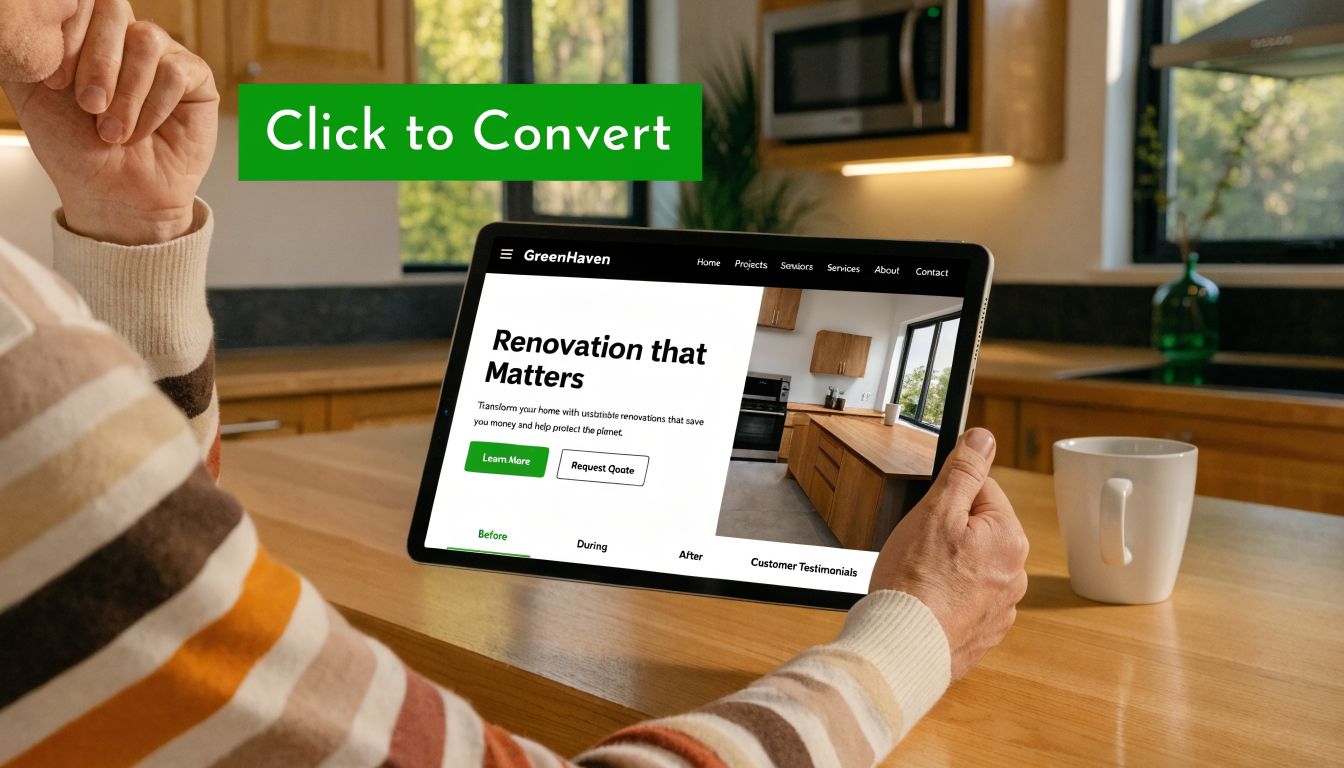
Too many contractors spend money on the click, then dump the visitor onto a generic homepage with too many options, weak photos, and no clear next step. That's like inviting a homeowner into your showroom and then leaving them alone in the dark.
Your ad makes a promise
When someone searches for a remodeler, your ad should speak clearly. Not clever. Not fancy. Clear.
Good contractor ads usually do a few things well:
- Name the service: Kitchen remodels, bathroom remodels, additions
- Show location fit: Mention the city or service area when appropriate
- Add a trust cue: Experience, craftsmanship, consultation, or portfolio
- Ask for one action: Schedule, call, or request an estimate
A homeowner searching for a major renovation isn't looking for abstract branding. They want to know, "Do you do the kind of work I need, in my area, and can I trust you?"
Why homepages waste paid clicks
For visual services, the landing page matters even more. For kitchen and bath remodeling, forcing a user to call with a Call-Only ad can be a mistake. Homeowners researching projects above $75K need to see a portfolio, and a landing page with a strong gallery and clear visuals can lead to 50% higher quality conversions compared to forcing a premature phone call, according to Footbridge Media's analysis of contractor Call-Only PPC.
That makes sense in real life. People don't hire a remodeler for a major project just because they saw a phone number. They want to see the work.
A strong landing page for paid traffic should include:
- A headline that matches the ad: If the ad says kitchen remodels, the page should open with kitchen remodels
- Project photos: Real work beats stock images
- A simple form: Name, contact info, project type, maybe timeline
- Trust signals: Reviews, awards, or clear proof of experience
- One main call to action: Don't give five exits
Homeowners shopping for a major remodel want proof before they want a sales call.
If you want examples of what that page experience should feel like, this guide on a remodeling website that converts visitors into leads is worth reading.
A homepage has a lot of jobs. Navigation, company story, service overview, careers, maybe blog content. A landing page has one job. Turn a paid visitor into a lead. Keep it focused.
Connecting Ads to Your Sales Process
Most contractor PPC advice stops too early. A lead comes in, and everyone claps. But a lead isn't revenue. It's just an opportunity.
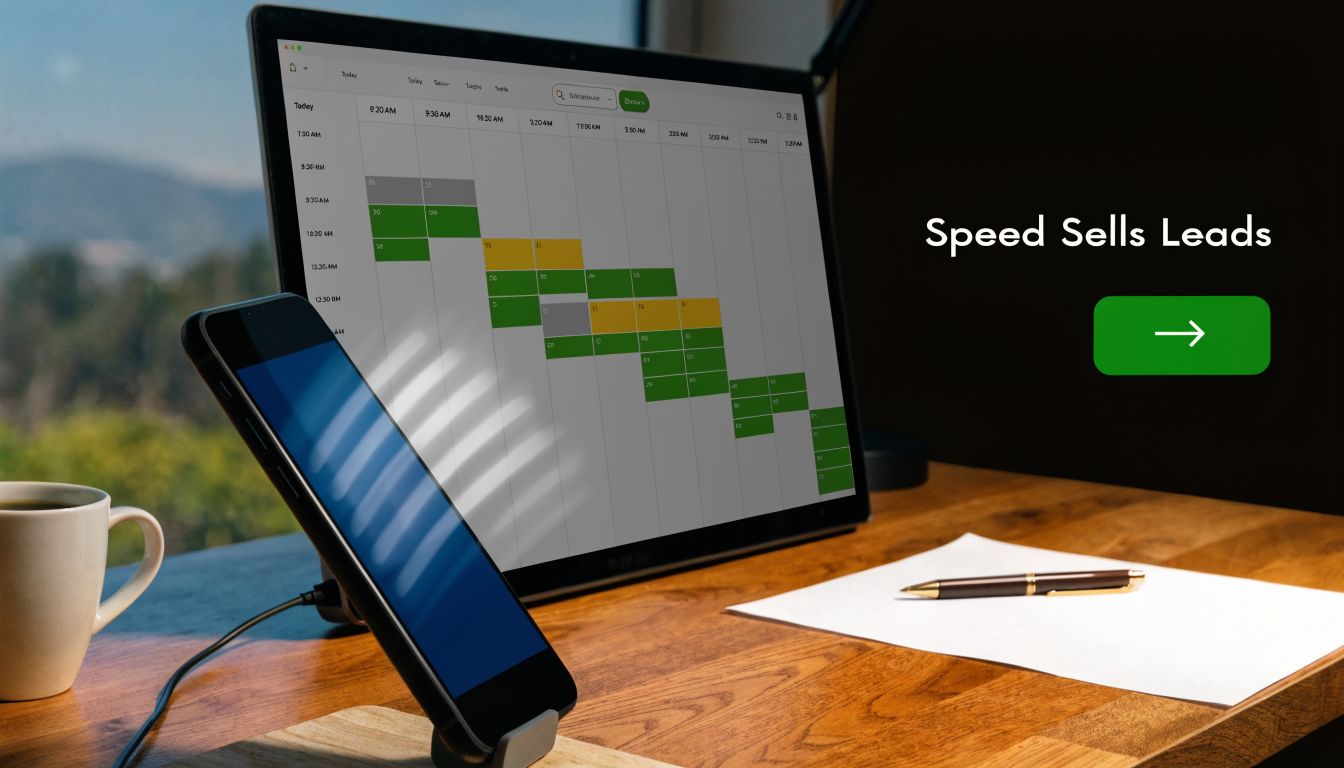
If you fish all morning, fill the boat, and then leave the fish sitting in the sun, you still lose the catch. PPC works the same way. Fast lead generation without fast follow-up wastes the hard part.
The digital doorbell idea
Start with conversion tracking. This is your digital doorbell. It tells you when someone filled out a form, called from an ad, or took another important action.
Without tracking, you're guessing. You might know money left your account, but you won't know which keywords, ads, or pages produced actual opportunities.
Good tracking usually includes:
- Form submissions: So you know which page brought the lead
- Phone call tracking: Since many contractor leads still prefer to call
- Basic lead source visibility: So your team knows the inquiry came from Google Ads
Once that doorbell rings, the next step matters more than most owners realize.
Why CRM follow-up changes the result
Most PPC guides for contractors overlook CRM integration. While call tracking gets mentioned, syncing leads from Google Ads into an automated follow-up system is rarely discussed. That gap matters because 70% to 80% of leads require at least five follow-up touches to convert, according to Blue Corona's contractor PPC resource.
That one idea changes the whole strategy.
If a homeowner fills out your form at lunch and hears nothing until tomorrow, you're already behind. A CRM can respond right away with a text, assign a reminder, and log the inquiry so no one forgets about it.
Think of a CRM as an automated assistant that never takes a lunch break. It can help with things like:
- Instant text response: A quick message confirming the inquiry came through
- Missed-call text back: Helpful when you're on-site and can't answer
- Task reminders: So estimates and callbacks don't disappear
- Lead tracking: So you can see what happened after the click
One option some remodelers use is an integrated system like lead generation support for contractors, which combines paid traffic with CRM-style follow-up tools. The key isn't the brand name. The key is making sure your ad platform and your follow-up system talk to each other.
The contractor who responds well usually beats the contractor who simply advertises well.
For high-ticket remodeling, this matters even more. Homeowners often compare firms, share ideas with a spouse, review galleries, and come back later. If your process depends on one person remembering to call every lead multiple times, leads will slip.
The smartest setup is simple. Ads bring in demand. Tracking records it. The CRM replies fast and keeps the conversation moving until your team takes over.
Making Your Ads Better Over Time
PPC is more like tuning an engine than setting a crock-pot. You don't turn it on and disappear. You check the gauges, listen for problems, and adjust.
Small improvements add up. Better keywords bring better traffic. Better pages bring better leads. Better follow-up helps your sales team close more of the right jobs.
The numbers that matter most
Don't drown in reports. Most contractors only need to watch a few key numbers each month.
One strong benchmark is cost per lead. For contractors, the average cost per lead from Google Ads was $70.11 in 2025, according to Red Door Marketing's contractor PPC cost breakdown. That doesn't mean every market or service will match it, but it gives you a benchmark to compare against.
The numbers to watch are usually:
- Cost per lead: How much you're paying to generate an inquiry
- Lead volume: Whether the campaign is producing enough opportunities
- Close rate: Whether those leads turn into jobs
- Search quality: Whether you're attracting the right type of homeowner
If your CPL is high but you're closing profitable projects, the campaign may still be healthy. If your CPL looks fine but the leads are junk, something is off upstream.
A simple monthly tune-up
Think like a tree trimmer. Keep the healthy branches. Cut the dead ones.
A practical monthly review looks like this:
- Pause weak keywords: Stop paying for searches that don't fit your work
- Add new negatives: Block irrelevant traffic you discovered in search terms
- Review ads: Keep the messages that attract qualified inquiries
- Check landing pages: Make sure photos, forms, and calls to action still work
- Compare leads to sales: Don't stop at click data
If your numbers stay flat for too long, look for friction. Maybe the page loads poorly on mobile. Maybe the ad promise doesn't match the page. Maybe calls go unanswered. The campaign and the sales process need to work together.
Pay per click advertising for contractors gets profitable when you treat it like a system, not a slot machine.
If you want help building that system, Constructo Marketing works with remodelers on Google Ads, websites, and CRM-connected follow-up so paid leads have a better chance of turning into booked jobs.