


You’re good at the hard part. You know how to price a job, manage subs, solve ugly field problems, and deliver a finished space that makes homeowners happy.
But lead flow still feels random.
One month the phone rings. The next month it goes quiet. Referrals are great, but they don’t arrive on a schedule. That’s why internet marketing for contractors matters so much. It gives you a way to create demand you can influence instead of waiting for someone else to send it.
The shift is simple. Stop treating marketing like a pile of separate tasks. Start treating it like a system. Search gets you seen. Ads create fast demand. Your website turns attention into trust. Your CRM keeps leads from getting lost. When those parts work together, your pipeline gets steadier.
Table of Contents
- Why Your Best Tool Might Be Your Keyboard
- Get Found First on Google Maps and Search
- Turn On the Faucet for Immediate Leads with Google Ads
- Make Your Website Your Best Salesperson
- Never Let a Lead Slip Through the Cracks Again
- Grow Smarter with Tracking and Market Exclusivity
Why Your Best Tool Might Be Your Keyboard
A lot of contractors hear “internet marketing” and think of fluff. Social posts. Fancy graphics. Someone asking for more budget without showing how it helps the business.
That’s not what matters.
Your keyboard might be your best tool because every word you put online helps a homeowner decide if you’re the right fit. A service page. A review response. A Google Business Profile update. A project description. Those small pieces act like signs on the busiest road in town.
And that road is crowded with buyers. Every month, approximately 1.7 million people in the U.S. search online for contractors, which works out to over 56,000 daily queries, according to contractor marketing statistics. If your company is hard to find online, those searches go to someone else.
Referrals are good, but they’re not a system
Word of mouth is like rainwater in a barrel. It’s useful, but you can’t control when it fills up.
Internet marketing is more like plumbing. You build pipes. You direct flow. You fix leaks. You know where the water is supposed to go.
Practical rule: If a homeowner can’t quickly see what you do, where you work, and why they should trust you, your marketing system is broken.
That’s why smart contractors don’t just “post more.” They build assets that keep working. Good service pages. Clean project galleries. Local search visibility. Follow-up systems. Useful educational content. If you need ideas for that last piece, this guide on types of content for content marketing is a practical place to start.
The real job of marketing
Marketing's job isn’t to make you look busy. It’s to help the right prospect take the next step.
That means your internet marketing for contractors strategy should answer basic buyer questions fast:
- Who are you? A homeowner wants a clear specialty, not a vague “full service contractor.”
- Do you work in my area? Local intent matters.
- Can I trust your work? Photos, reviews, and process clarity do that.
- What should I do next? Call, book, or request a consultation.
A lot of owners overcomplicate this. They chase every trend and copy big brands. You don’t need that. You need a clear local presence and a system that matches how people shop for remodeling services online. If you want a broader view of what’s changing, these 2026 digital marketing strategies are worth reviewing through the lens of your own market.
Get Found First on Google Maps and Search
When someone types “kitchen remodeler near me” or “bathroom renovation contractor,” Google is deciding who gets seen first. Local SEO helps you become one of those businesses.
Google Maps is the modern main street. Your Google Business Profile is your storefront sign. Your website is the showroom behind the door. If either one looks neglected, the buyer keeps walking.
A key part of local SEO is your Google Business Profile because 46% of all Google searches are for local information, and an optimized profile with weekly photos and consistent reviews can boost Maps visibility by up to 70%, based on this digital marketing for contractors breakdown.
Start with your Google Business Profile
Many contractors treat GBP like a listing they set once and forget. That’s a mistake. Google wants fresh signals that show your business is active and trusted.
A solid profile should include:
- Accurate business details: Name, phone, service area, hours, and categories should all match your site and other listings.
- Recent project photos: Not stock images. Real kitchens, baths, additions, roofs, and outdoor spaces.
- Review activity: Ask happy clients for reviews, and answer every review in a calm, professional way.
- Regular updates: Project posts, service highlights, and short updates show life.
If your team needs a practical walkthrough, this guide to a Google Business Profile for contractors covers the basics in contractor language.
A neglected GBP is like a yard sign left in the mud after the job is done. People see it, but it doesn’t build confidence.
Make your website say what you do and where you do it
Your website pages need to match the searches you want to win.
That means one clear page for kitchen remodeling. One for bathroom remodeling. One for additions. One for design-build. Each page should say where you work and show proof of the work. Don’t hide your service areas in tiny footer text and hope Google figures it out.
Simple works better than clever here. A homeowner doesn’t search for “premium living transformations.” They search for “home addition contractor” or “kitchen remodeler” in their city.
Use this quick checklist:
- Write clear page titles with the service and location.
- Show real project photos that match the service on the page.
- Add trust signals like testimonials, certifications, and process details.
- Link related pages together so visitors can move naturally through the site.
- Track rankings over time so you know what’s improving and what’s stuck. If you want a simple process, this article on how to check site ranking in Google is useful.
SEO is slower than ads, but it compounds. A strong local search presence can keep sending leads even when you’re not actively increasing spend. That’s why the best internet marketing for contractors plans don’t treat Google Maps, service pages, and reviews as separate chores. They treat them as one machine.
Turn On the Faucet for Immediate Leads with Google Ads
SEO builds your reputation over time. Google Ads lets you buy attention right now.
That’s why I compare ads to a faucet. You can turn them on when you want lead flow now. You can turn them down when your schedule is full. But if the faucet is connected to the wrong pipes, you pay for water that never reaches the sink.
A well-managed Google Ads campaign for contractors can achieve a ROAS of 4:1 to 8:1, and using exact match keywords with tight geo-targeting can improve lead quality by 60% while cutting wasted ad spend by 40%, according to this contractor Google Ads methodology.
Bad ads buy clicks, smart ads buy conversations
A lot of contractors lose money in Google Ads for one reason. They target broad, sloppy terms.
“Contractor” is sloppy. “Remodeling” is sloppy. “Home renovation” can be sloppy if your firm only wants larger design-build projects.
Better targeting looks more like the actual words a serious homeowner uses when they’re close to action. Service plus location. Specialty plus location. High-intent phrases, not curiosity phrases.
Here’s the difference:
- Weak targeting: General terms that attract DIY searches, job seekers, and low-budget shoppers.
- Better targeting: Specific service phrases tied to the cities and neighborhoods you serve.
- Best targeting: Search terms that match your ideal project type, your ideal homeowner, and your real service radius.
This is also where geography matters. If you work a tight radius, your ads should follow that radius. If you know certain zip codes produce better-fit projects, your settings should reflect that. Good paid search management is mostly about saying “no” to the wrong traffic.
A contractor who wants quality leads should also look at a page like pay-per-click advertising for contractors to understand how campaign structure affects lead quality before spending heavily.
Field-tested advice: The keyword is only half the job. The other half is making sure the click lands in the right place.
Your landing page has to finish the job
If your ad says “Luxury Kitchen Remodeling in Your City,” don’t send that click to a generic homepage with ten menu options and a stock photo.
Send it to a page built for that exact search.
That page should do three simple things well:
| Page element | What it should do | What usually goes wrong |
|---|---|---|
| Headline | Match the service the person searched for | Generic wording that feels disconnected |
| Proof | Show photos, reviews, and credibility | Pretty design with no trust |
| Call to action | Make calling or booking simple | Too many buttons or buried contact info |
The best ads feel like one smooth sentence from search to click to call. The worst ads feel like a bait-and-switch.
Google Ads works best when you already know your ideal service mix, your service area, and the value of a qualified lead. Without that, ads can still generate activity, but not always the kind you want. For internet marketing for contractors, paid search is powerful because it creates immediate demand. It only becomes profitable when the targeting, page, and follow-up all agree on who you want.
Make Your Website Your Best Salesperson
Your website doesn’t need to win design awards. It needs to help a homeowner trust you enough to call.
That’s a different goal.
Many contractor sites are built like brochures. They talk about the company, list a few services, throw in some photos, and hope that’s enough. But a good website should behave more like your best salesperson. It should answer questions clearly, handle objections early, and guide the visitor toward one next step.
A good site answers the same questions your best estimator does
When a serious homeowner lands on your website, they’re asking a short list of questions in their head.
Do these people do the kind of work I want?
Do they look organized?
Can I trust them in my house?
What happens if I contact them?
Your site should answer those questions without making the visitor hunt.
A strong contractor site usually includes:
- Clear service pages that separate kitchens, baths, additions, roofing, or outdoor living instead of lumping everything together.
- Project photos that prove craftsmanship rather than generic lifestyle images.
- Testimonials and reviews placed near decision points, not hidden on one lonely page.
- Obvious contact paths like a phone number in the header and a short form that doesn’t feel like homework.
- A process page so the homeowner can see how your company works.
Your website should feel like a clean showroom. Easy to walk through. Easy to understand. Easy to trust.
What to fix first
You don’t need a complete rebuild to improve performance. Usually, the first wins come from removing friction.
Here are the most common fixes that matter:
Simplify the homepage
Put your main service, service area, and core call to action near the top.Improve image quality
Real project photography beats polished but generic branding every time in this industry.Reduce confusion
If every page asks the visitor to do something different, they stall.Speed up the site
Slow pages make prospects leave before they see your work.Tighten conversion paths
If you want more calls and consultations, study proven conversion rate optimization techniques and apply the simple ones first.
A website should support every other part of your marketing. SEO brings people in. Ads send targeted traffic. Reviews support trust. Then the site closes the gap between interest and contact. If that handoff fails, the rest of the system works harder than it should.
Never Let a Lead Slip Through the Cracks Again
A homeowner finds your company on Google at 8:17 p.m., fills out the form, then calls because they want to know if you handle full-home remodels in their neighborhood. Nobody answers. By morning, that same homeowner has already talked to two other contractors.
That is how good leads get wasted. Not because demand was weak, and not because the marketing failed. The break happens in the handoff between interest and follow-up.
Your CRM is the brain, not just a contact list
A lot of remodelers hear “CRM” and picture a bloated database no one wants to use.
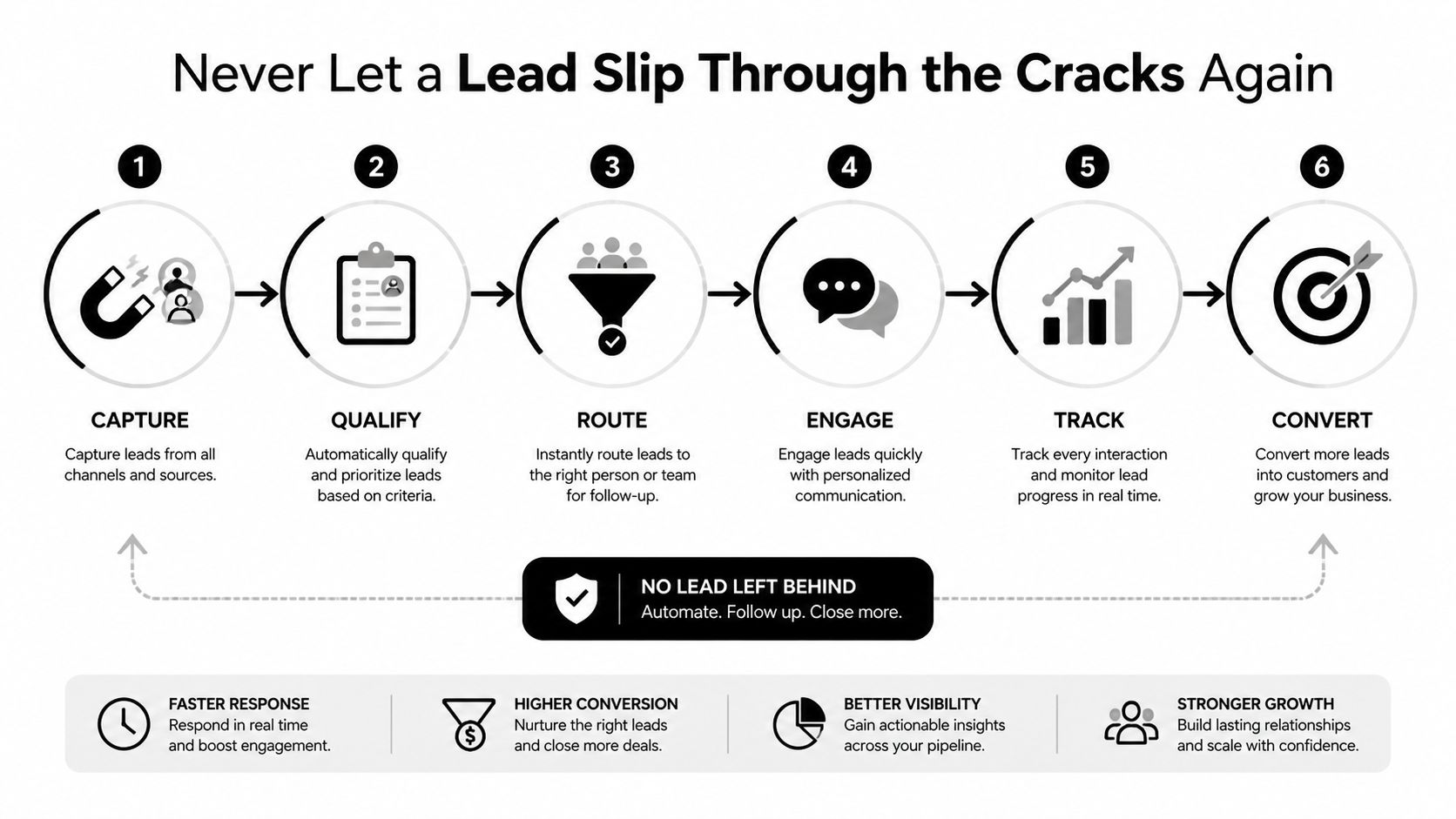
A useful CRM is a smart clipboard with memory and follow-through. It stores where the lead came from, logs calls and messages, tracks the last conversation, and tells your team what needs to happen next. That matters because internet marketing for contractors only works as a system when SEO, ads, the website, and follow-up all connect.
Without that connection, every channel gets harder to judge. You may know leads are coming in, but you will not know which source brings real projects, where response time slows down, or how many estimates die in limbo.
A good CRM should answer practical questions fast:
- Which leads came from Google Maps versus ads?
- Who called but never got reached?
- Which prospects asked for a consultation but never booked?
- How many open opportunities are sitting idle?
That visibility changes decisions. Instead of saying, “marketing feels slow lately,” you can see that form leads are booking while missed calls are being lost after hours.
Two automations that save real opportunities
The highest-value automations are usually the least glamorous.
First, set up a missed-call text back. If someone calls while the owner is in a client meeting, on a jobsite walk-through, or driving between projects, the system sends a polite reply right away. That buys time and keeps the lead warm.
Second, build automated follow-up for leads that go quiet. A lot of prospects do not reject the project. They get busy, talk to a spouse, wait on financing, or they forget. Short check-in messages keep your company in front of them without asking your office staff to remember every next step.
Here’s what that safety net looks like:
| Lead problem | What usually happens without a system | What automation does |
|---|---|---|
| Missed phone call | The prospect moves on fast | Sends an immediate text response |
| Form submitted after hours | Reply waits until the next day | Starts acknowledgment instantly |
| Estimate not scheduled | Lead goes cold in the shuffle | Triggers reminders and task follow-up |
| Old lead still undecided | Nobody checks back in | Keeps light contact going |
Speed matters here. The first contractor to respond often gets the first real conversation, and in many cases, that decides who makes the shortlist.
I have seen companies spend heavily on SEO and Google Ads, then lose the return because nobody owned follow-up after 5 p.m. or on weekends. That is why CRM should not sit off to the side as office software. It needs to be part of the lead generation machine itself.
Constructo Marketing, for example, pairs lead generation with a whitelabeled GoHighLevel CRM for tracking and automated follow-up. The brand matters less than the setup. What matters is having one connected system, so the click, call, form, response, appointment, and sale all live in the same pipeline.
That is how you stop treating marketing as a stack of separate tactics. You build one machine that captures demand, routes it fast, and keeps good opportunities from leaking out.
Grow Smarter with Tracking and Market Exclusivity
Most owners don’t need more marketing reports. They need a simple dashboard that tells them if the machine is healthy.
Think about your truck. You don’t need a lecture every time you drive it. You just need to know the fuel level, speed, and whether something is overheating. Marketing works the same way.
Use a simple dashboard
If you track too much, you’ll ignore it. If you track too little, you’ll guess.
The middle ground is best. Watch the few numbers that connect spending to revenue. That tells you whether your internet marketing for contractors system is producing the kind of work you want.
Here’s a simple version.
| Metric | What It Tells You | Good Target |
|---|---|---|
| Marketing spend | Whether investment matches your growth plan | A level you can sustain while measuring return |
| Lead volume | Whether visibility is turning into inquiries | Consistent qualified leads, not just more names |
| Lead quality | Whether the right homeowners are contacting you | Projects that fit your service mix and budget range |
| Booked appointments | Whether leads are moving into real conversations | A steady flow of consultations from qualified inquiries |
| Closed jobs | Whether marketing is producing revenue, not noise | Enough wins to support profitable growth |
That’s the dashboard. Simple. Useful. Actionable.
If you can’t tell which channel produced a lead and whether that lead turned into a job, you’re not managing marketing. You’re funding it blindly.
Why exclusivity matters when you expand
There’s one issue many remodelers don’t think about until it hurts them. Agency conflict.
An emerging trend for scaling contractors is multi-market exclusivity. Data indicates contractors who expand regionally with geotargeted ads see 2.5x more lead volume, but 60% fail if they don’t have an exclusivity deal, which leads to internal bid wars against other clients of the same agency, according to this article on innovative digital marketing ideas for local contractors.
That matters more than most owners realize.
If your agency serves multiple remodelers in overlapping areas, you can end up financing your own competition. Same playbook. Same channels. Same neighborhoods. Even if nobody says it out loud, conflict creeps in.
Market exclusivity fixes that problem. It gives you protected territory. It also makes regional growth cleaner because you can add nearby markets without worrying that your own partner is setting up another contractor against you.
This is especially important for firms trying to grow beyond one core city. Expansion works best when the system stays disciplined. One market at a time. Clear tracking. Tight geo-targeting. No internal cannibalization.
If you want a marketing system instead of disconnected tactics, Constructo Marketing is built around that model for remodelers. The focus is simple: local SEO, Google Ads, conversion-focused websites, CRM follow-up, and market exclusivity working together so your lead flow is easier to measure, easier to protect, and easier to scale.