


Most advice about general contractor marketing is backwards.
It tells you to pick a tactic. Run some ads. Post on Facebook. Fix your website. Ask for reviews. Maybe write a blog. That sounds useful, but it usually creates a pile of disconnected parts. You don't need more parts. You need a machine.
You're already good at the hard part. Building projects, managing crews, solving problems, keeping jobs moving. The frustrating part is that your marketing often feels less organized than your job site. Leads show up randomly. Some are junk. Some ghost you. Some call while you're on a ladder, and by the time you call back, they're gone.
That's not a traffic problem alone. It's a system problem. Good general contractor marketing isn't about chasing one shiny tactic at a time. It's about building one simple path from first search to signed contract, then automating the parts that shouldn't depend on you being glued to your phone.
Table of Contents
- Why Most Contractor Marketing Feels Like a Leaky Faucet
- Build Your Unshakeable Digital Foundation
- Become the First Call with Local SEO and Google Ads
- Use Content to Answer Questions and Build Trust
- Install a System to Capture Every Single Lead
- Measure What Matters to Your Bottom Line
- Your 90-Day Marketing Implementation Checklist
Why Most Contractor Marketing Feels Like a Leaky Faucet
A lot of contractors think the problem is visibility. Sometimes it is. But more often, the actual problem is leakage.
You spend money to get attention. A homeowner clicks. They land on a weak website, or a half-finished Google profile, or a page that talks about your company but doesn't help them take the next step. Then they leave. Or they call and no one answers. Or they fill out a form and wait too long. That's a leaky faucet. Money goes in. Opportunities drip out.
Meanwhile, demand is there. The global home services market is valued at $485 billion, and there are 1.7 million monthly online searches for contractors in the U.S.. PPC campaigns in this space also see a 10.22% conversion rate, which tells you people are willing to hire online when the system is built right, according to these contractor marketing statistics.
The myth you need to drop is this: more tactics equal more leads.
Wrong. More disconnected tactics usually create more confusion. A Facebook post doesn't fix a bad landing page. A new website doesn't fix slow follow-up. Google Ads don't save you if you target the wrong area. SEO doesn't help much if your Google Business Profile is incomplete and your reviews are stale.
Practical rule: If your marketing relies on you manually stitching everything together, it will break when you get busy.
That matters even more for high-value residential work. Homeowners spending serious money don't hire based on one flashy ad. They compare. They click around. They look at photos. They read reviews. They test your credibility before they ever speak to you.
So stop asking, "Should I do SEO or ads?"
Ask better questions:
- Can the right homeowner find me
- Does my digital presence make me look trustworthy
- Can they contact me fast
- Does my follow-up happen even when I'm on a job site
- Can I see which lead sources turn into real jobs
If those pieces don't connect, you're not running marketing. You're patching leaks.
If you want a sharper breakdown of the common mistakes, this article on what contractors get wrong about digital marketing and how to finally get it right is worth your time.
Build Your Unshakeable Digital Foundation
Your digital foundation has two jobs. First, make a stranger trust you. Second, make it easy for that stranger to contact you.
Most contractor websites fail at one of those jobs, and a shocking number fail at both. They look dated, load slowly, bury the phone number, and use vague copy like "quality craftsmanship" instead of showing the actual work, actual locations, and actual services.
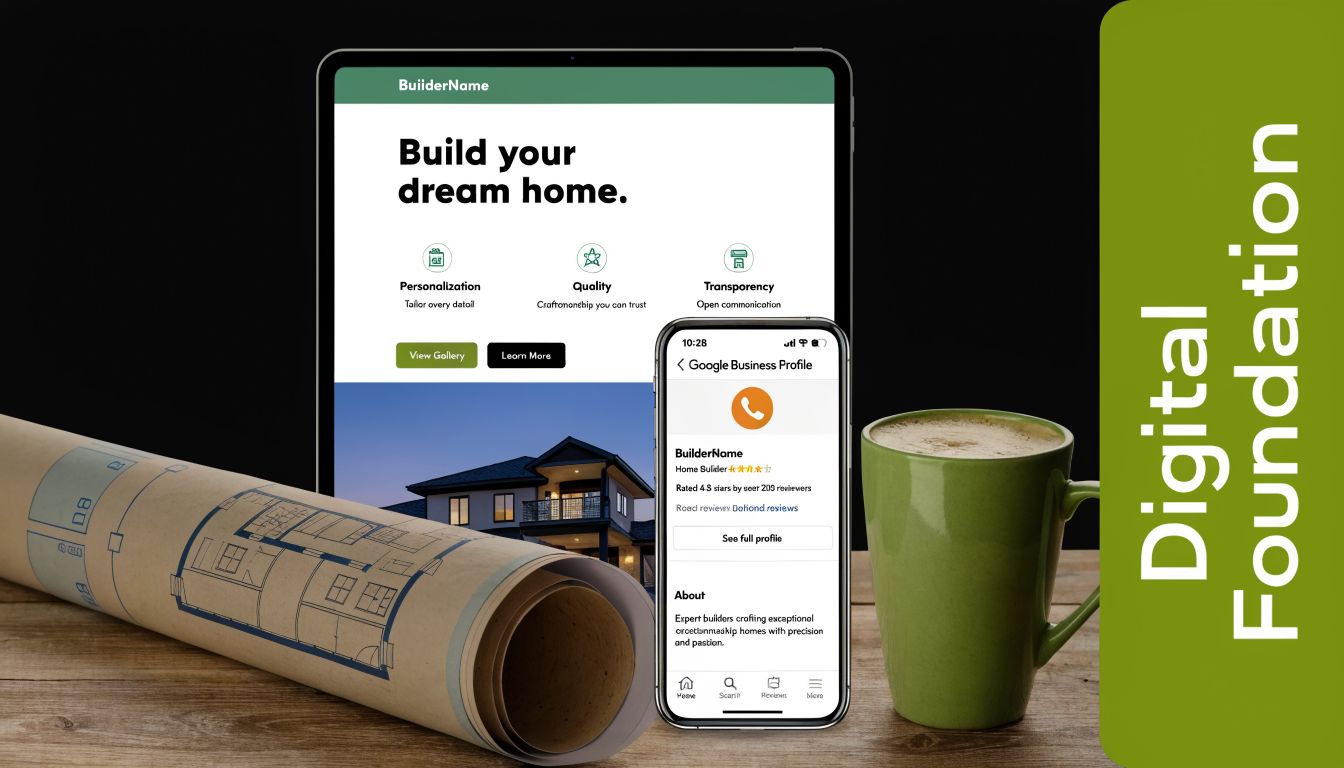
An integrated system starts with a custom website and a fully optimized Google Business Profile because the Google Maps pack drives nearly 50% of local search clicks, and incomplete profiles are a major reason contractors lose visibility and leads, as noted in this guide to SEO for home builders.
Your website is your showroom
Think of your website like your cleanest, best-finished project. If a homeowner lands there, they should understand three things in a few seconds:
- What you do
- Where you do it
- How to contact you
Don't make people dig.
A strong contractor site needs:
- Clear service pages that name the actual work. Kitchen remodels, home additions, roofing, bathroom renovations, outdoor living. Not just "our services."
- Location signals that tell Google and homeowners where you work. Cities, neighborhoods, counties, service areas.
- Project photos with context so visitors can see the kind of jobs you want more of.
- Simple calls to action like call now, request an estimate, or book a consultation.
- Fast mobile experience because a lot of homeowners will find you on their phone.
If you're reworking your site, this breakdown on how to design a remodeling website that converts visitors into leads gives a practical model.
Your Google Business Profile is your roadside sign
Your website is the building. Your Google Business Profile is the sign out front on the busiest road in town.
A lot of contractors set it up once and forget it. That's a mistake. Google uses that profile to decide whether you're relevant for local searches, especially map-based searches with strong intent.
Fill out every part:
- Primary category and supporting categories that match what you sell
- Service areas that reflect where your crews work
- Business description in plain language
- Hours
- Phone number
- Website link
- Photos of real jobs
- Review collection plan
Here's a simple comparison that matters:
| Part | Weak version | Strong version |
|---|---|---|
| Services | "Home improvement" | "Kitchen remodeling, bathroom remodeling, home additions" |
| Photos | Logo and one truck photo | Recent project photos with real work shown |
| Service area | Broad and vague | Specific cities and neighborhoods |
| Reviews | Random and passive | Ongoing request process after project milestones |
A complete profile does two things at once. It helps Google understand your business, and it helps homeowners feel safe calling you.
What contractors usually miss
The common misses aren't fancy technical problems. They're basic details left undone.
- Outdated photos make an active company look dead.
- Wrong categories tell Google the wrong story about your business.
- Thin service pages make you look generic.
- One page for everything weakens your relevance for specific searches.
- No review process hands trust to competitors.
You don't need a giant website. You need a clean one. You don't need a clever Google profile. You need a complete one.
When the foundation is solid, the traffic you buy or earn has somewhere useful to land.
Become the First Call with Local SEO and Google Ads
A lot of contractors get bad advice here too. They hear that SEO is the long game and ads are the fast game, then they choose one and ignore the other. That's too simple.
The better way to think about it is this. Local SEO builds the road. Google Ads buys speed on the road. If you only buy speed, you keep paying forever. If you only build the road, you may wait too long for volume.
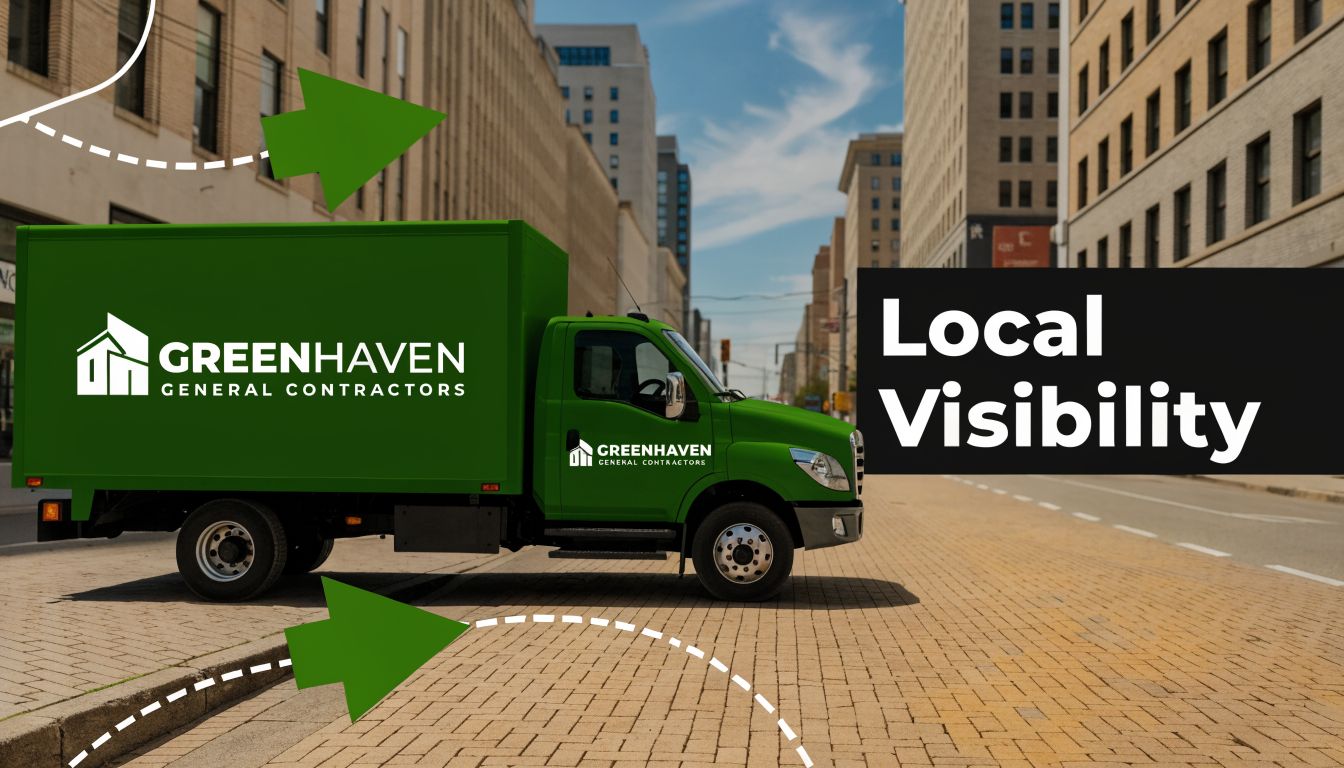
For Google Ads, the smart play is targeting service-specific keywords like "kitchen remodel near me" and geo-targeting to specific zip codes. SEO builds long-term authority, while ads give immediate top-of-page placement for high-intent searches, according to this Google Ads for contractors guide.
Local SEO builds the road
Local SEO isn't magic. It's clarity plus consistency.
Google needs enough evidence to believe you're a strong answer for a local search. That evidence comes from your website pages, your Google Business Profile, your service-area relevance, your reviews, and the way your business information appears across the web.
For a contractor, the core Local SEO work usually looks like this:
- Create separate service pages for each major service you want to rank for
- Create location-relevant pages only where you can make them useful
- Match your services to your profile and page copy
- Keep your business information consistent
- Use project photos and project descriptions that support local relevance
What you should not do is pump out junk pages for every town around you. Thin, duplicate location pages make your site weaker, not stronger.
A better model is simple. Build a real page for a real service in a real place where you want real jobs. If you do kitchen remodels in one city and home additions in the next, say that plainly. Show proof.
Google Ads buys speed
Ads are not a slot machine. They work when you stay narrow.
A contractor campaign should usually be organized around specific services, specific areas, and specific intent. Someone searching "general contractor" might be browsing. Someone searching "kitchen remodel near me" is much closer to action.
Use these filters:
- Service-first campaigns so your ad copy matches the search
- Geo-targeting by city, zip, or radius so you don't pay for clicks outside your service area
- Landing pages that match the ad so the visitor doesn't have to guess what happens next
Here's the simplest way to avoid wasted spend:
| Ad setup choice | Bad version | Better version |
|---|---|---|
| Keywords | Broad, vague terms | Service-specific, high-intent terms |
| Geography | Entire metro area by default | Only the zip codes and cities you serve |
| Landing page | Generic homepage | Dedicated page for the service searched |
| Follow-up | Manual and inconsistent | Tracked and routed into CRM |
If a homeowner searches for one thing and lands on a page about ten different things, you create doubt. Doubt kills calls.
How to split the work without wasting money
Most established contractors should treat SEO and ads differently based on timing.
Use SEO for the services and places you want to own long term. Use Google Ads to cover immediate demand, seasonal pushes, or gaps where you're not ranking yet.
That means:
- If you're entering a new service area, ads can create immediate visibility
- If you already have project history and reviews in an area, SEO should keep compounding
- If a service has high urgency, ads usually deserve faster testing
- If a service is high-ticket and research-heavy, SEO content plus retargeting usually supports better decisions
One useful supporting asset is a fully dialed-in map presence. If you want to tighten that part of the system, review this guide to Google Business Profile for contractors.
The point isn't to become a marketing nerd. The point is to stop spending like a tourist. Be specific. Buy intent. Build authority where you want to stay.
Use Content to Answer Questions and Build Trust
A lot of contractors hear "content marketing" and immediately tune out. I get it. It sounds like blogging for the sake of blogging.
That's not what matters.
Content is just pre-selling. It answers the questions a homeowner has before they trust you enough to call. For a high-ticket remodel, they want to know what the process feels like, what kind of projects you really do, whether you understand their type of home, and whether you're going to communicate like a pro.
Stop thinking blog and start thinking answers
Your future client is already asking questions. They're typing them into Google, asking AI tools, checking reviews, and comparing what they find.
So give them useful answers:
- What does a kitchen remodel process look like
- How do you handle design-build projects
- What should a homeowner prepare before an addition
- What makes one roofing estimate different from another
- How long does the planning stage usually take
You don't need perfect prose. You need clear explanations.
If you're using AI to support research and planning, study a strong generative AI strategy so you use the tools with intention instead of dumping generic machine-written pages onto your site. AI can help you organize questions, cluster topics, and outline answers. It should not replace your real-world judgment.
Homeowners don't hire the contractor who uses the fanciest words. They hire the one who makes the confusing stuff feel clear.
What content actually helps a remodeler sell
The highest-value content for general contractor marketing is usually not "industry news." It's practical proof.
Start with these:
- Project galleries with short writeups. Say what the client wanted, what problems came up, and what changed.
- FAQ pages that answer common pre-sale questions in plain English.
- Service pages that explain your process, not just your features.
- Comparison content that helps homeowners think through choices.
- Team and process content that shows how you communicate, plan, and manage jobs.
Here's a dead simple test. If a homeowner read this page before calling, would the conversation be easier? If yes, keep it. If not, cut it.
You don't need ten posts a month. You need useful pages that remove fear:
- fear of being overcharged
- fear of a messy process
- fear of poor communication
- fear of hiring the wrong crew
Your content should calm those fears before the sales call starts.
Install a System to Capture Every Single Lead
Here, most contractors lose money they never even count.
They spend time and money getting the phone to ring, then the lead hits voicemail because they're in a crawl space, on a roof, driving between jobs, or talking to a crew member. The lead doesn't wait. The lead calls the next contractor.
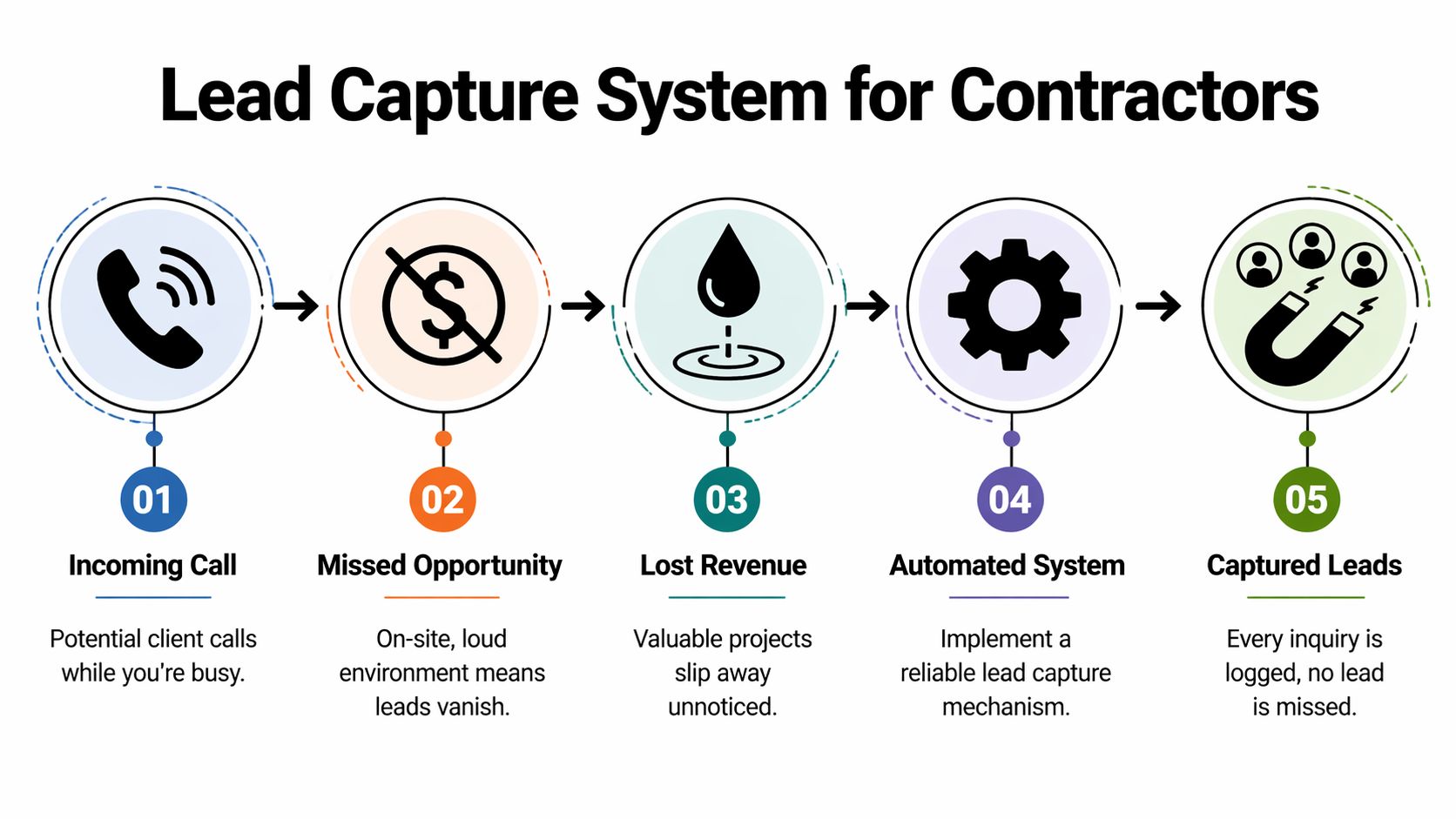
That gap is brutal because response time matters more than most contractors want to admit. Up to 70% of contractor leads go cold if follow-up doesn't happen within 5 minutes, and a CRM with automation can improve close rates by 20-30% through missed-call text-back and follow-up sequences, based on this contractor marketing analysis.
Speed wins before sales skill does
A lot of owners think the sales problem starts when they get someone on the phone. Nope. It starts earlier.
The first sale is the callback. If you lose that moment, your estimate skills don't matter, your portfolio doesn't matter, and your close rate doesn't matter. You never got a shot.
That's why I push contractors to install one integrated lead capture system instead of juggling a contact form, personal cell phone, office line, sticky notes, and memory.
The system should do four things fast:
- Capture the inquiry
- Acknowledge it immediately
- Assign it clearly
- Track what happens next
A missed call is not a small admin problem. It's a broken handoff in your sales process.
What your automated receptionist should do
A CRM is just a digital system that remembers things and triggers actions. It operates like a front-desk person who never sleeps, never forgets, and never loses a phone number.
Your setup should include:
- Missed-call text-back so callers hear from you even when you can't answer
- Instant lead logging so every form, call, and message lands in one place
- Simple pipeline stages like new lead, contacted, estimate scheduled, estimate sent, won, lost
- Follow-up reminders so warm leads don't disappear
- Source tracking so you know whether the lead came from SEO, ads, referrals, or something else
If you're exploring conversational tools, an AI chatbot for general contractors can also help capture after-hours questions and route inquiries into your workflow, especially when paired with human follow-up instead of replacing it.
One option in this category is Constructo Marketing, which pairs lead generation with a whitelabeled GoHighLevel CRM for missed-call text-back, follow-up automation, and KPI tracking. That's the kind of connected setup more contractors need, whether they build it in-house or through a partner.
The simple workflow to install
Don't overcomplicate this. A clean workflow beats a fancy one.
Step one
Every call, form, and message enters one CRM.Step two
If nobody answers, the system sends an automatic text that acknowledges the inquiry and invites a reply.Step three
The lead gets tagged by service type and area.Step four
A team member gets a task to call back.Step five
If the lead doesn't respond, the system sends a short follow-up sequence.
That sequence shouldn't sound robotic. It should sound like a real business owner who respects the homeowner's time.
For example:
"Sorry we missed your call. We're on a job site right now, but we'd be happy to help. Text us a few details about your project and best callback time."
That's not hype. That's just good operations.
Measure What Matters to Your Bottom Line
If you ask a contractor how marketing is going, a lot of times you'll hear vague answers.
"We're getting traffic."
"People are seeing us."
"Our posts are doing better."
"We got some leads."
None of that tells you whether the system is making money.
Contractors who track core KPIs see 35% more revenue growth than those who don't, and 88% of consumers trust online reviews as much as personal recommendations, according to these 2026 contractor marketing tips. That should tell you two things. First, measurement matters. Second, reputation and conversion belong in the same conversation.
Vanity metrics are a distraction
Website traffic is not the finish line. Impressions are not the finish line. Likes are definitely not the finish line.
If your marketing agency sends pretty charts but can't tell you which leads turned into sold jobs, you don't have reporting. You have decoration.
The KPIs that matter most for general contractor marketing are simple:
- Cost per qualified lead
- Lead-to-appointment rate
- Appointment-to-estimate rate
- Estimate-to-job close rate
- Cost per acquired job
- Review volume and review quality
- Lead source by revenue, not just lead count
If you want a plain-language refresher on KPI basics, this guide to understanding key performance indicators (KPIs) is useful.
A simple contractor KPI dashboard
Don't build a monster spreadsheet nobody uses. Build a short dashboard you can review every week.
Here is a practical version:
| KPI | What it tells you | Why it matters |
|---|---|---|
| Qualified leads | Whether the top of the funnel is healthy | Shows if targeting is attracting the right people |
| Close rate | Whether your sales process works | Reveals if leads are good and follow-up is strong |
| Cost per lead | What you're paying for opportunity | Helps you compare channels honestly |
| Cost per job | What it takes to win revenue | Ties marketing to actual business results |
| Review trend | Whether trust is growing | Impacts both conversion and local visibility |
Keep each lead tagged by source. Then ask:
- Which source brings the best jobs
- Which source brings time-wasters
- Which pages create calls
- Which zip codes produce profitable work
- Which estimator closes best
That last point matters. Sometimes the "marketing problem" is really a sales or process problem. KPI tracking exposes that fast.
Your 90-Day Marketing Implementation Checklist
You don't need to do everything today. You need to do the right things in order.
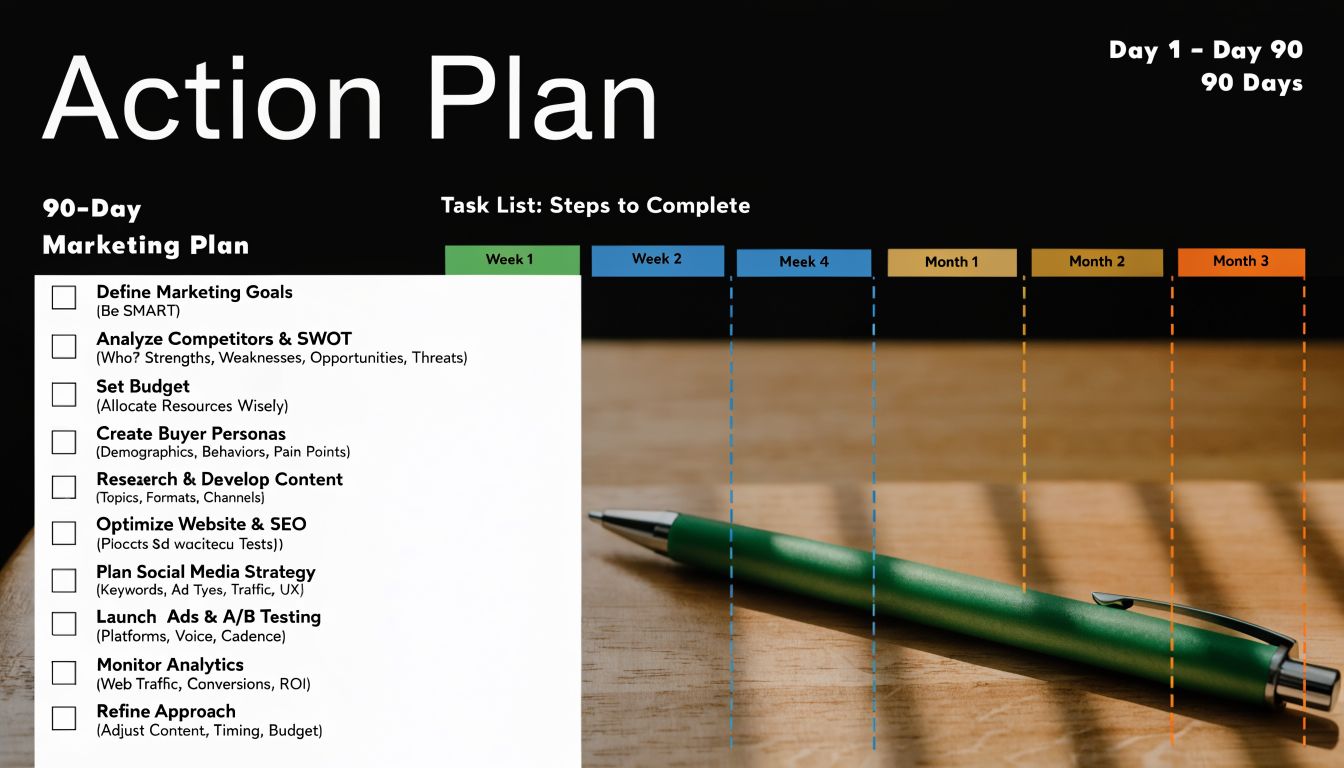
Days 1 through 30
Start with the foundation and lead capture.
- Audit your website for speed, clarity, service pages, and calls to action
- Complete your Google Business Profile with correct categories, services, photos, hours, and service areas
- Choose one CRM and route all calls, forms, and messages into it
- Turn on missed-call text-back
- Create or clean up your core service pages
Days 31 through 60
Now drive better traffic and build trust.
- Launch or refine Local SEO work around your core services and target locations
- Set up Google Ads for service-specific, high-intent searches in the exact areas you serve
- Build a few trust pages such as FAQs, project galleries, and process pages
- Ask for reviews consistently at the right points in the customer journey
Days 61 through 90
Shift into measurement and refinement.
- Build a weekly KPI dashboard
- Tag every lead source
- Review close rates by source and service
- Pause what brings junk leads
- Put more budget behind what brings qualified opportunities
- Tighten follow-up scripts and automations
Don't chase perfect. Build the machine, then tune the machine.
If you're tired of random marketing activity and want a connected system that covers SEO, Google Ads, website conversion, CRM automation, and KPI visibility, take a look at Constructo Marketing. They focus on remodelers and contractors who want reliable local lead flow instead of one-off tactics.