Published Apr 23, 2026
You’ve probably seen this happen.
A homeowner gets three bids for the same remodel. One contractor has solid work but a dated logo, a patchy website, mismatched truck graphics, and proposals that look like they were built in a rush. Another contractor may not be dramatically better at swinging the hammer, but everything feels organized, clear, and professional. Guess who often gets the callback.
That gap is branding a construction company in real life. Not the fluffy version. The practical version. The kind that helps a remodeler win better-fit clients, protect margin, and stop looking interchangeable with five other companies in the same town.
Think of brand like a house. If the foundation is crooked, fresh paint won’t save it. If the plan is clear, the materials match, and the finish is consistent, people trust what they’re looking at before they inspect every detail. Homeowners do the same thing with your business.
Table of Contents
- Why Your Brand Is More Than Just a Logo
- Laying Your Brand's Foundation with Research
- Creating Your Business Blueprint and Message
- Designing Your Company's Look and Feel
- Building Your Online Job Site
- Using Your Brand to Attract Great Clients
- Your Final Brand Punch List and Rollout
Why Your Brand Is More Than Just a Logo
A logo is one piece of the job. It’s not the whole build.
If your brand were a house, the logo would be the front door color. Important, yes. But nobody decides the house is trustworthy because the door is painted well. They decide based on the whole experience. Does the place feel solid? Clean? Thought through? Does everything match?
That’s what branding a construction company really means. It’s the full system people see and feel: your truck wrap, website, estimate template, job site sign, crew shirts, email signature, photography, tone of voice, and follow-up process. When those pieces line up, homeowners assume your projects will line up too.
The real job of a brand
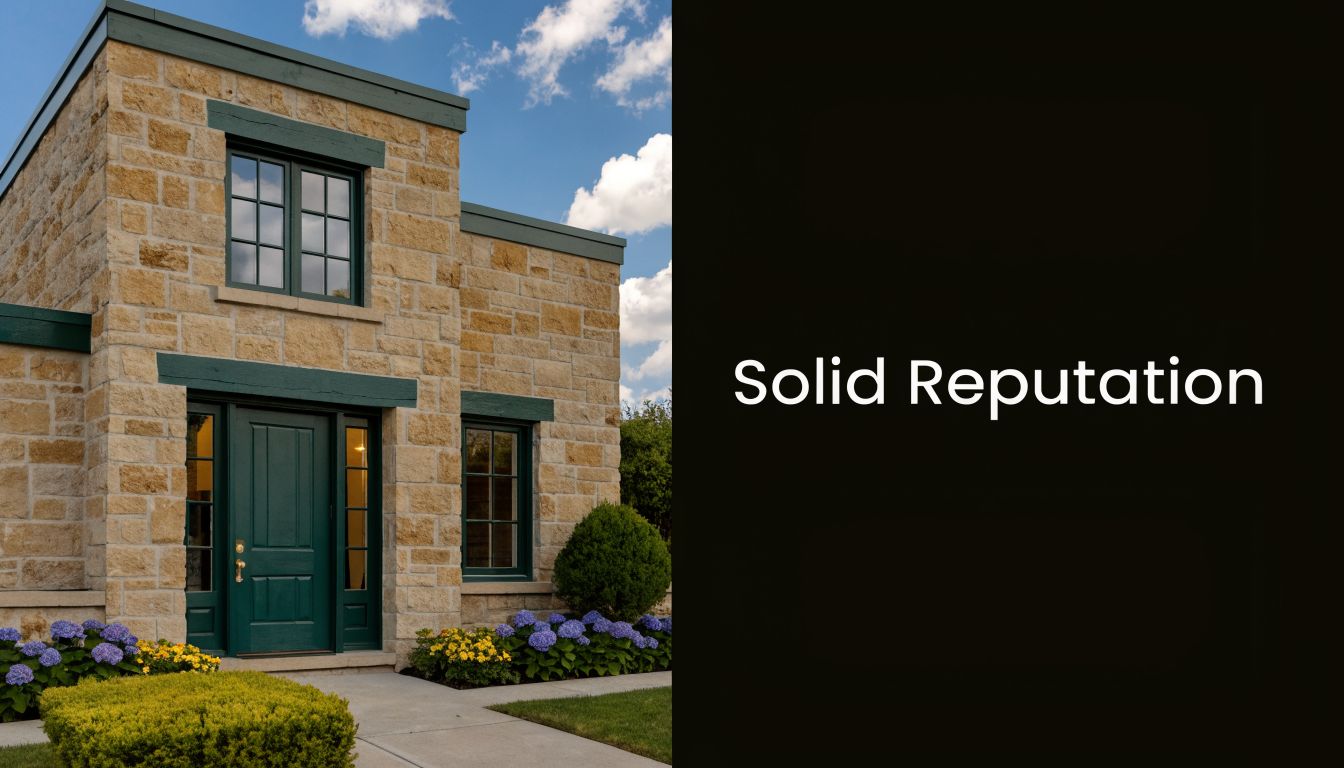
Homeowners usually can’t judge technical details the way you can. They may not know which builder uses the tighter process, the better sequencing, or the smarter material spec. But they can spot sloppiness fast.
They notice when your proposal looks clean. They notice when your photos feel professional. They notice when your website says one thing and your social media says another. They notice when your company feels dependable before they’ve even met you in person.
Practical rule: If your marketing feels patched together, clients assume your project management might be patched together too.
That’s why branding isn’t decoration. It’s pre-sold trust.
Why it affects revenue
This isn’t just opinion. Research cited by Don Creative Group shows that consistent branding can increase revenue by up to 33% for businesses, and the same source also notes a range of 10% to 20% for consistent brand presentation, which matters directly for remodelers trying to win higher-value residential work (construction branding revenue impact).
For a remodeler pursuing larger residential jobs, that can mean the difference between competing on price and being able to command confidence. People will often pay more for a company that feels organized, credible, and steady.
A lot of contractors make one big mistake here. They treat brand like a one-time purchase. Get a logo, print some cards, done. But a strong brand behaves more like a repeatable field process. It needs standards. It needs consistency. It needs maintenance.
If you want a simple outside resource for tightening up the basics, these actionable small business branding tips are useful because they focus on real-world touchpoints, not marketing theater.
Laying Your Brand's Foundation with Research
Before you build a deck, addition, or kitchen, you look at the site first. You don’t start cutting lumber and hope the plan appears later.
Branding works the same way. Research is the site survey.
Most contractors skip this part because they think they already know the market. Then they end up sounding exactly like every other remodeler in town. Same claims. Same photo style. Same “quality craftsmanship” line. Same race to the bottom.
Stop trying to be for everyone
One of the hardest parts of branding a construction company is accepting that a broad message usually creates weak positioning.
A strong local brand doesn’t try to own every type of job for every kind of homeowner. The better move is to own a corner of the market. Contractor Growth Network points to this clearly: remodelers need to stop being generalists and claim a sub-niche, such as “the kitchen remodel expert for historic homes”, because without that focus, you become just another contractor competing on price instead of unique value (local construction branding guide).
If the homeowner can swap your name with three other companies and the sentence still works, your positioning is too generic.
That doesn’t mean you can only perform one service. It means your brand should be known for something specific.
What to research before you change anything
You don’t need a giant market study. You need honest answers.
Use this short field checklist:
Your best past jobs
Look at the projects you actually enjoyed. Which ones were profitable, smooth, and led to referrals?Your best clients
Which homeowners respected your process, made decisions on time, and valued quality over the cheapest number?Your competitors nearby
Review their websites, Google Business Profiles, yard signs, Instagram feeds, and proposal style. Don’t copy them. Look for sameness and gaps.Your reputation themes
Read your reviews. What words come up over and over? Clean communication? Design help? Reliability? Craftsmanship? That’s signal.
Build a simple ideal client sheet
Keep this dead simple. One page is enough.
Write down:
- The project type you want more of.
- The homeowner type you work best with.
- The neighborhoods or towns you want to be known in.
- The problem they’re trying to solve.
- The reason they choose a contractor like you.
That’s your brand footing.
A remodeler who says, “We do kitchens, baths, additions, decks, basements, roofing, flooring, painting, and handyman work for anyone,” sounds busy but blurry. A remodeler who says, “We help established homeowners modernize older homes without losing their character,” sounds memorable.
One message creates price shoppers. The other creates fit.
Creating Your Business Blueprint and Message
Once the ground is surveyed, you need the blueprint.
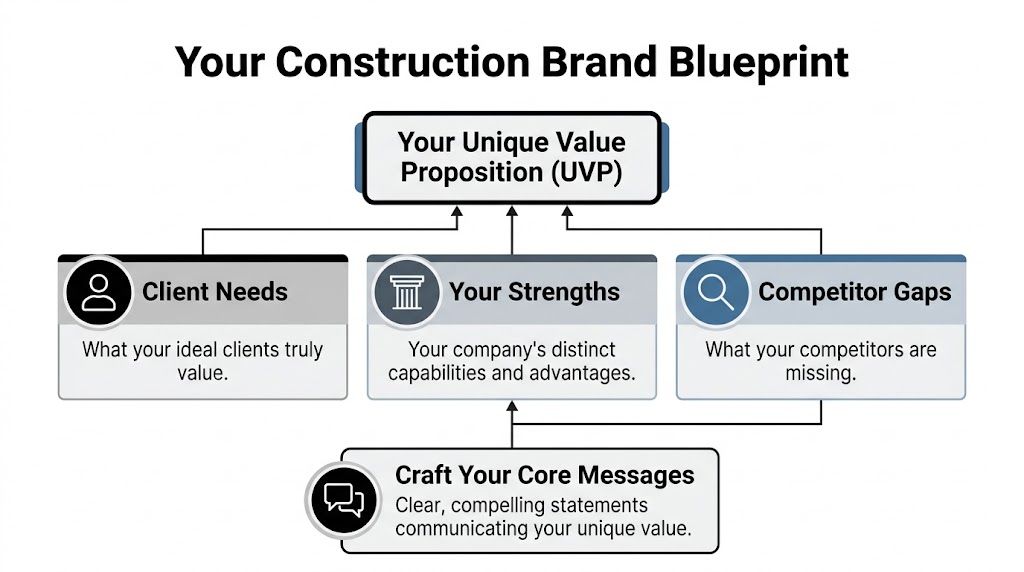
In branding, that blueprint is your Unique Value Proposition, or UVP. That’s just a simple answer to one question: Why should a homeowner hire you instead of the other contractor down the road?
Not the fake version. Not “we care about quality.” Every contractor says that. The useful version is specific enough that a homeowner can repeat it back to someone else.
A simple way to write your UVP
Start with this fill-in-the-blank:
We help [type of homeowner] complete [type of project] with [specific strength or process] so they get [clear result].
Examples:
- We help busy families remodel kitchens with a clear step-by-step process so the job feels organized from design to final walkthrough.
- We help owners of older homes update bathrooms without stripping away the original character.
- We help homeowners planning major additions avoid confusion through tight communication, realistic scopes, and polished project documentation.
Those examples work because they sound like real businesses. They don’t sound like brochure filler.
Pull your message from three places
Your strongest message usually sits where these three things overlap:
| Input | What to ask | What good answers sound like |
|---|---|---|
| Client needs | What do homeowners worry about most? | “I don’t want surprises” or “I need a contractor who communicates.” |
| Your strengths | What do you do unusually well? | “Our change-order communication is clean” or “Our design-build process is tight.” |
| Competitor gaps | What are others doing poorly? | “They post projects, but they don’t explain process or trust.” |
When those line up, your messaging gets teeth.
A practical outside reference that complements this thinking is DesignGuru’s Small Business Branding Guide. It’s helpful because it pushes you to connect identity, messaging, and consistency instead of treating them as separate tasks.
Turn one message into three repeatable points
Your UVP is the master blueprint. Your core messages are the rooms inside it.
Pick three ideas you want repeated everywhere:
- On your homepage
- In sales calls
- On your proposals
- In job site signage
- In your project photos and captions
A remodeler’s three message pillars might be:
Clear communication
Homeowners know what’s happening, what’s next, and who to call.Specialized craftsmanship
The company is known for a certain project type or housing style.Professional process
The business feels organized before demolition even starts.
If you want more ways to express those pillars through content, these video content ideas for remodeling clients are a smart next step because video forces you to say your value clearly, not hide behind vague copy.
Designing Your Company's Look and Feel
Now you’re into curb appeal.
Your visual brand is the part people notice first, but it only works when it reflects the message underneath. A polished logo for a confused company still feels confused. Good design doesn’t rescue weak positioning. It reveals strong positioning faster.
What each visual piece should do
Think of your visual identity like finish selections in a remodel. Each choice sends a signal.
| Brand Element | What It Is | Simple Tip |
|---|---|---|
| Logo | Your main identifying mark | Keep it clean enough to work on trucks, shirts, signs, and a website header |
| Colors | Your core brand palette | Pick a small set and use them everywhere instead of changing shades constantly |
| Fonts | The type styles in your materials | Choose readable fonts that look professional on both screens and print |
| Photography | Images of your work and team | Show the kind of projects you want more of, not every random job |
| Layout style | How your materials are arranged | Keep spacing, headings, and button styles consistent across documents and pages |
A common contractor mistake is chasing “cool” instead of clear. Fancy script fonts, busy logos, shiny gradients, too many colors. That stuff usually ages fast and reproduces poorly.
Match the look to the job you want
A company pursuing high-end kitchen and bath remodels shouldn’t look like a discount handyman service. The reverse is also true. If your visuals look too corporate or too cold, homeowners may assume you’ll be hard to work with.
Use simple questions:
- Does this look trustworthy on a proposal?
- Will this still read clearly on a yard sign?
- Does this fit the homes we want to work on?
- Would a homeowner remember this after seeing three competitors?
Your brand doesn’t need to win a design award. It needs to look organized, readable, and consistent in the places buyers actually see it.
Don’t forget real-world applications
Many rebrands often fall apart at this stage. The logo looks nice on a white screen, but nobody checks how it performs on a dark truck wrap, embroidered polo, or dusty job site banner.
Before locking anything in, test your visuals on:
- Truck doors
- Yard signs
- Business cards
- Proposal covers
- Website header
- Social profile image
- Crew apparel
If you’re thinking about uniforms, hats, or branded shirts, this complete guide to custom apparel is useful because construction branding lives in practice, not just in a brand file.
Good visual identity should feel like a clean finish package. Nothing random. Nothing fighting for attention. Just steady, professional choices that make your company easy to recognize.
Building Your Online Job Site
Your website is not a brochure. It’s your digital job site.
It’s where homeowners inspect your business before they ever call, and many of them decide whether you feel trustworthy in a matter of seconds. If that experience is messy, slow, outdated, or thin, you’ve already lost ground.

Why your digital presence matters so much
The demand is already there. According to WebFX, there are 1.7 million online searches for independent contractors each month, and 62% of customers will ignore a business if it doesn’t have a website (construction marketing search data).
That tells you two things.
First, homeowners are actively looking. Second, a weak or missing web presence knocks contractors out of the running before craftsmanship even enters the conversation.
A lot of remodelers still treat the site like a placeholder. Home page, a few stock phrases, contact form, done. That won’t carry a premium brand.
What a good contractor website needs
A strong remodeling website should do four jobs at once:
Show the right work
Feature the kinds of projects you want more of. If you want kitchens and additions, don’t lead with random repair jobs.Explain your process
Homeowners want to know what it feels like to work with you. Clear steps reduce fear.Build trust
Use real project photos, testimonials, team images, and clean copy. Avoid vague claims.Make contact easy
Calls, forms, and next steps should be obvious.
One of the best ways to pressure-test your site structure is to review examples of a remodeling website that converts visitors into leads. The useful lesson isn’t style alone. It’s how message, trust, and action all work together.
Your Google Business Profile is part of the brand
Your website gets a lot of attention, but your Google Business Profile often becomes the first real inspection point.
That profile should match your brand just like your site does:
- Same logo
- Same service focus
- Same tone
- Same quality photos
- Same local positioning
If your website says “high-end design-build remodeler” but your profile photos look random and your business description sounds generic, the brand breaks right there.
Homeowners don’t separate your website, reviews, map listing, and photos into different buckets. They see one company. Your job is to make that company feel consistent everywhere.
Think of the website as the model home and the Google profile as the roadside sign. Both need to point to the same builder.
Using Your Brand to Attract Great Clients
A good brand doesn’t just sit there looking nice. It pulls better leads toward you.
A lot of contractors get the order backward. They buy ads, post on social, or ask for SEO help before they’ve nailed the message. Then they wonder why the traffic feels weak or the leads feel wrong. Marketing works better when the brand underneath it is clear.

Brand makes your marketing easier to believe
If your company is clearly positioned, every marketing channel gets sharper.
Local SEO becomes easier because you’re not trying to rank for every service under the sun. Your content gets stronger because you know which homeowner questions to answer. Your paid ads get cleaner because the landing page and ad copy tell the same story.
That’s why a structured branding process matters. Ascent Consults describes a 5-step methodology of Discovery, Messaging, Design, Deployment, and Tracking, and notes that firms using this process can improve proposal hit rates by 15% to 25% and increase website traffic by over 30% (construction branding methodology).
Those gains make sense because the business stops improvising. It starts repeating the same solid message across every channel.
Where to use the brand every week
Think of your brand like the sign package on a new commercial build. It tells the right people where to go.
Use it in:
- Local SEO pages that focus on your best services and towns
- Project spotlights that show your process, not just before-and-after shots
- Google Ads that match the promise on your landing page
- Review requests and follow-up emails that sound like your company, not a generic template
- Your Google Business Profile, which should reinforce the same positioning homeowners see elsewhere
If you’re tightening your local visibility, this guide to a Google Business Profile for contractors is helpful because it connects local search presence to trust, not just rankings.
What works and what doesn’t
Here’s the plain version.
What works
- Repeating the same message across search, ads, web, and sales
- Showing real project photos tied to the niche you want
- Answering homeowner concerns in simple language
- Using your brand to pre-qualify the right type of buyer
What doesn’t
- Running ads to a generic home page
- Posting random project photos with no story
- Saying you do everything for everyone
- Using one tone in ads and another in sales conversations
When the brand is right, the lead often arrives warmer. Not always sold, but less confused. That changes the whole sales conversation.
Your Final Brand Punch List and Rollout
The best brand strategy in the world can still fail during rollout.
This is the punch list stage. You’ve made the plan. You’ve chosen the materials. Now you walk the site and check every last detail so nothing gets missed.
That matters because inconsistency wrecks trust faster than most contractors realize. Develop Coaching reports that 65% of construction firms that fail at branding do so because of inconsistent messaging, and that inconsistency can reduce customer trust by 30%. The same source recommends a quarterly audit of brand touchpoints to keep things aligned (construction brand consistency guidance).
Your rollout checklist
Don’t launch halfway. Update everything a homeowner or referral partner might see.
Use this punch list:
Website pages
Home page, service pages, about page, contact page, project galleryGoogle-facing assets
Business profile logo, photos, description, service categoriesSales materials
Estimates, proposal templates, presentation decks, financing sheetsField materials
Job site signs, truck wraps, crew apparel, business cardsDaily communication
Email signatures, voicemail greeting, scheduling messages, follow-up emailsSocial channels
Profile image, cover image, bio, pinned posts, highlight covers
If one of those still reflects the old brand or a different message, homeowners feel the wobble.
A brand rollout isn’t complete when the logo is done. It’s complete when the customer can’t find a weak spot.
What to track after launch
You don’t need a giant dashboard to know whether the brand is helping. Start with a few practical checks:
- Are better-fit leads coming in?
- Are homeowners mentioning the kinds of projects you want?
- Are proposals feeling easier to present?
- Are prospects less confused about what makes you different?
- Is the team using the same language in calls and emails?
Then set a calendar reminder every quarter and audit the basics:
- Does every touchpoint still match?
- Are you showing the right work?
- Are your core messages still visible?
- Are old files or outdated graphics still floating around?
Brand drift is normal if nobody owns it. Assign one person to police the details.
The contractors who get the most from branding a construction company aren’t always the ones with the fanciest design. They’re usually the ones who keep the whole system straight. Same message. Same look. Same promise. Everywhere.
If you want help turning your brand into a lead system instead of a pile of disconnected marketing pieces, Constructo Marketing specializes in helping remodelers become Local Famous, attract $75K to $300K residential projects, and build a tighter engine across SEO, Google Ads, websites, and follow-up. It’s a practical fit for contractors who want more than a prettier logo. They want a brand that helps win work.